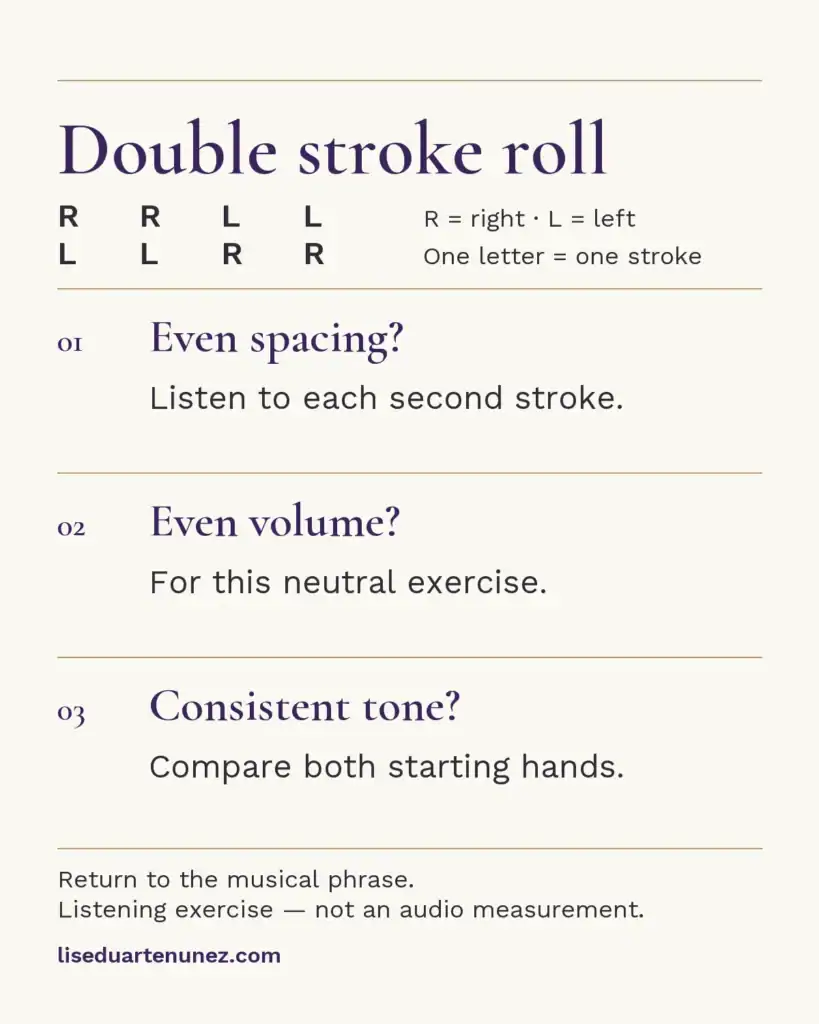
A double stroke roll alternates two strokes from one hand with two from the other: RRLL RRLL. To practise it usefully, listen beyond speed. Are the notes evenly spaced? Does the second stroke disappear or become an unintended accent? Can you hear a change when the other hand takes over?
This guide proposes a short listening exercise for open doubles on snare drum. It separates three questions—spacing, volume and tone—so that the next attempt has a clear purpose. It is not a universal grip prescription or a promise of a faster roll.
What is a double stroke roll?
The Percussive Arts Society identifies the Double Stroke Open Roll as rudiment No. 6. Its international rudiment chart shows repeated right-right, left-left strokes and distinguishes this category from multiple-bounce rolls.
Here, R means one right-hand stroke and L means one left-hand stroke. Each letter is one intended audible note, not an instruction to allow an unspecified number of rebounds.
That distinction matters on orchestral snare drum. An open double stroke roll is not interchangeable with every sustained roll in a score. Do not assume that playing doubles faster automatically makes them a buzz or multiple-bounce roll. Establish the required sound with the score and your teacher before choosing the technique.
Define “even” before trying to play faster
For the first exercise, choose a steady pulse and a comfortable, deliberately uniform dynamic. Judge these features separately:
| Listening question | What to notice |
|---|---|
| Spacing | Does the time between notes change inside a pair or between hands? |
| Volume | Is the second stroke noticeably louder or quieter than the first? |
| Tone | Does the sound change within a pair or when hands change? |
An accent you intend is not an error. The neutral version simply gives you something consistent to compare before adding musical shaping. “Even” does not mean that every future phrase must remain at one dynamic.
Vic Firth’s Double / Triple Beat exercise explicitly asks players to attend to rhythmic and dynamic consistency. It comes from a marching-percussion resource. The listening criteria are useful here; its specific movement descriptions and practice surfaces are not being prescribed as a single orchestral method.
Double stroke roll exercises: RRLL and LLRR
Use the same sticks and playing surface for both versions. Choose a pulse slow enough to distinguish the notes without forcing the movement, and note the dynamic you intend. A teacher can help you choose a workable starting point; there is no target BPM in this exercise.
The following grid is an original teaching example, not a passage from a published study. In 4/4, each column is one eighth note:
| Count | 1 | & | 2 | & | 3 | & | 4 | & |
|---|---|---|---|---|---|---|---|---|
| Right-leading | R | R | L | L | R | R | L | L |
| Left-leading | L | L | R | R | L | L | R | R |
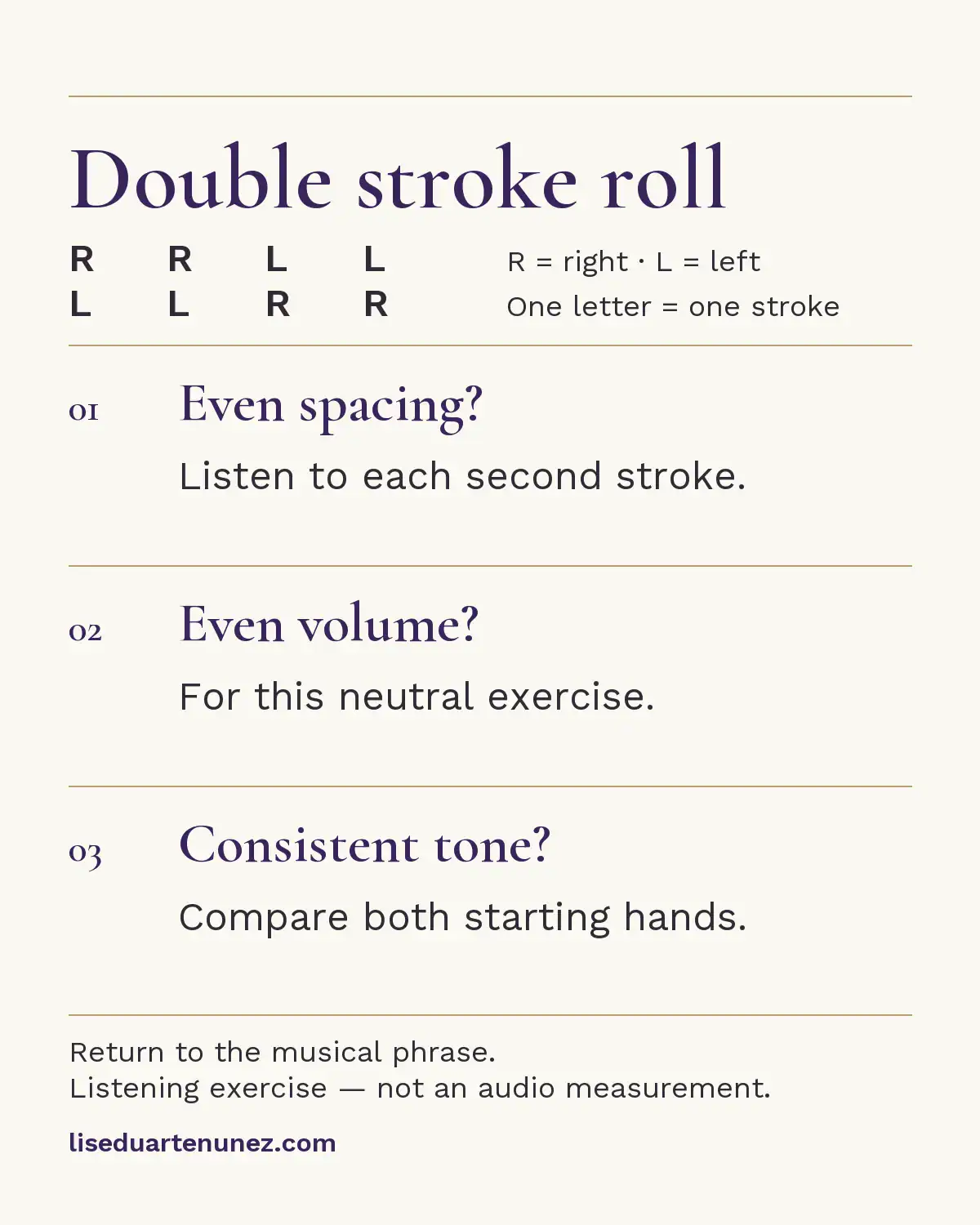
The visual’s three questions in text: Even spacing? Listen to each second stroke. Even volume? For this neutral exercise. Consistent tone? Compare both starting hands.
Play the right-leading bar, then leave a full bar of silence. Repeat with the left-leading version at the same pulse and intended dynamic. The silence is for resetting and listening, not a rule about performing the rudiment.
Do not add an accent simply because a new pair or bar begins. For this neutral comparison, all eight notes share the same intended volume. If a difference appears, describe where it occurs before deciding how to respond.
Listen to the second stroke without forgetting the first
For one attempt, attend to the second note of each pair. For the next, listen to the connection between pairs. A pair may sound satisfactory on its own while the transition from one hand to the other interrupts the line.
Do not automatically solve a quieter second stroke by making everything louder. First check whether the difference is repeatable at the chosen pulse and dynamic. The appropriate movement adjustment depends on the player, instrument and task; a written description cannot determine it from the sound alone.
Record one question, not an entire practice session
Record a short right-leading and left-leading attempt with the same setup. Use the percussion practice recording guide for placement and playback rather than changing microphone position between versions.
Before replaying, write one question: “Can I hear the second left-hand stroke as clearly as the first?”, for example. Listen once for that question, then once for the complete line.
| What you hear | A bounded next attempt |
|---|---|
| A pair sounds compressed or stretched | Repeat a shorter section at a pulse where you can follow each subdivision. |
| Second strokes are less audible | Keep the intended dynamic clear and ask your teacher to examine how the pair is produced. |
| The change between hands is noticeable | Compare right-leading and left-leading versions with the same conditions. |
| Playback is distorted or changes level unexpectedly | Check the capture before treating the recording as evidence of a playing problem. |
These are listening prompts, not diagnoses. A recording cannot by itself identify the physical cause of an uneven pair, and a phone’s processing can alter the apparent balance.
Add dynamic control deliberately
Once you have a comparison you can describe, change one condition. You might repeat the neutral exercise at a different intended dynamic while keeping the pulse, surface and recording position unchanged.
Ask whether both strokes remain present at the new level and whether the hand change becomes more noticeable. Do not assume that a solution at one dynamic transfers unchanged to another. If increasing speed makes the result harder to judge, return to a pace where the question is audible rather than treating speed as proof of control.
There is no endurance challenge here. Stop if playing becomes uncomfortable; this article does not assess pain or provide a physical diagnosis.
Return the doubles to a phrase
Try this original two-bar example in 4/4:
- Bar 1: eight eighth notes,
RRLL RRLL, with the neutral dynamic used above. - Bar 2: one right-hand quarter note on beat 1, followed by quarter-note rests on beats 2, 3 and 4. Allow the drum’s natural decay; the rests mean no further strokes in this exercise, not a prescribed damping action.
Listen to whether the last pair connects to the following downbeat. Then try the mirrored version: LLRR LLRR, followed by a left-hand quarter note. Only after the connection is clear should you introduce a deliberate dynamic shape and compare it with your neutral version.
This is not an orchestral excerpt or a report of Lise’s performance. It gives the isolated doubles a beginning, a destination and space to listen afterwards.
For a different musical problem, the Delécluse Étude No. 6 guide addresses ornaments within a phrase. The Pique Dame guide examines sticking choices in context. Neither is a substitute for identifying the roll required in your own score.
Choose the next attempt from what you heard
A useful conclusion is specific: “the spacing stayed steady, but the second left stroke became quieter at the softer dynamic.” That gives the next attempt a clearer purpose than “my roll is bad” or “I need more speed.”
If you would like individual feedback on a particular passage or practice question, explore the focused online percussion lessons. You can discuss your project; bookings and payments are not open yet.
Sources and further practice
- Percussive Arts Society, 6. Double Stroke Open Roll: official rudiment page with notation and demonstration resources; consulted 18 October 2026.
- Percussive Arts Society, International Drum Rudiments, first-page roll categories and sticking; consulted 18 October 2026.
- Vic Firth, Double Stroke (Open) Roll: rudiment and application resources; consulted 18 October 2026. Follow the source for its demonstrations; none is presented as Lise’s own video.
- Vic Firth, Marching Percussion 101, Exercise 3: Double / Triple Beat: listening for rhythmic and dynamic consistency, within its stated marching context; consulted 18 October 2026.