Four-mallet technique on marimba is not only about reaching four notes. It also lets you decide which notes should lead and which should support them. If every attack attracts the same attention, a melody can become difficult to follow even when all the pitches are correct.
This guide proposes a short exercise for players already introduced to holding and using four mallets. The question is musical: can you still follow the intended line when the accompaniment returns? It is not a first lesson in grip, a fixed sticking system or a promise of rapid independence.
Four mallets, different musical roles
Yamaha’s marimba playing guide describes four-mallet playing as two mallets in each hand. That arrangement does not, by itself, tell you what each note should contribute.
In Classical Techniques for Jazz Mallets, James Walker discusses using four mallets for multiple lines and for accompaniment beyond a single block-chord texture. His article approaches these resources from a jazz perspective. Here, the narrower task is to distinguish a melody from its supporting harmony in an original exercise—not to reproduce his examples or prescribe their stickings.
Before playing a passage, mark its roles:
- Which line should the listener follow?
- What does the accompaniment supply: pulse, harmony, movement or another character?
- Do those roles stay the same throughout the phrase?
Do not automatically label the highest note “melody” or assign the melody permanently to the right hand. Read the music. A bass or inner voice may become the leading line, and an accompaniment can have its own direction.
Choose a manageable four-mallet task
Keep your existing, teacher-approved grip and suitable mallets. Check that the notes and intervals are comfortable for your current level. Do not force a stretch or change grip simply to copy an example on a page.
Julia Gaines’s Sequential Studies lesson 2 identifies single-independent strokes with static intervals and double-vertical strokes with stepwise motion as distinct topics in a learning sequence. That is a useful reminder to keep the present task bounded. This article does not claim to teach those movements from a written listening prompt, and the linked video’s demonstrations have not been analysed here.
If a passage asks for a movement you have not learnt, work on that with your teacher first. Balance is difficult to evaluate when merely reaching the notes takes all your attention.
An original melody-and-accompaniment exercise
This is a constructed one-bar example in 4/4, not a quotation from repertoire or a report of Lise’s performance. C4 means middle C. Each entry is a quarter-note attack on the numbered beat:
| Role | Beat 1 | Beat 2 | Beat 3 | Beat 4 |
|---|---|---|---|---|
| Melody | C5 | D5 | E5 | C5 |
| Accompaniment chord | C4–E4–G4 | C4–E4–G4 | C4–E4–G4 | C4–E4–G4 |
The accompaniment is one musical layer containing three notes; this is not two-part counterpoint. In the combined version there are four notes at each attack: one melody note and the three accompaniment notes. Strike them together, without adding a roll or arpeggio. The quarter-note values organise the rhythm; they are not instructions to damp every bar after exactly one beat.
Have your teacher confirm a workable distribution of the four mallets and the widest interval. No mallet numbering or hand assignment is imposed here. If the example is not suitable, use a short passage you already play comfortably, with clearly identified melodic and accompanying material.
Leave a bar of silence between attempts. That pause gives you time to recall the intended sound; it is not an extra bar added to a real composition.
Hear the parts separately, then together
Use a steady pulse at which the notes remain manageable. For this comparison, keep the instrument, mallets, register and listening position unchanged.
- Melody alone. Play C5–D5–E5–C5 and decide how the line should move towards its return. Retain its rhythm and intended dynamic.
- Accompaniment alone. Play the three-note chord on each beat. Listen for a stable supporting pattern without assuming that support must be expressionless.
- Together. Restore all four notes on each beat. Can you still follow the melody’s movement, or does the repeated chord take over your attention?
The separate versions help you hear the musical roles. They are not proof that the same physical actions will transfer unchanged when the parts are combined.
A listening framework, not a score
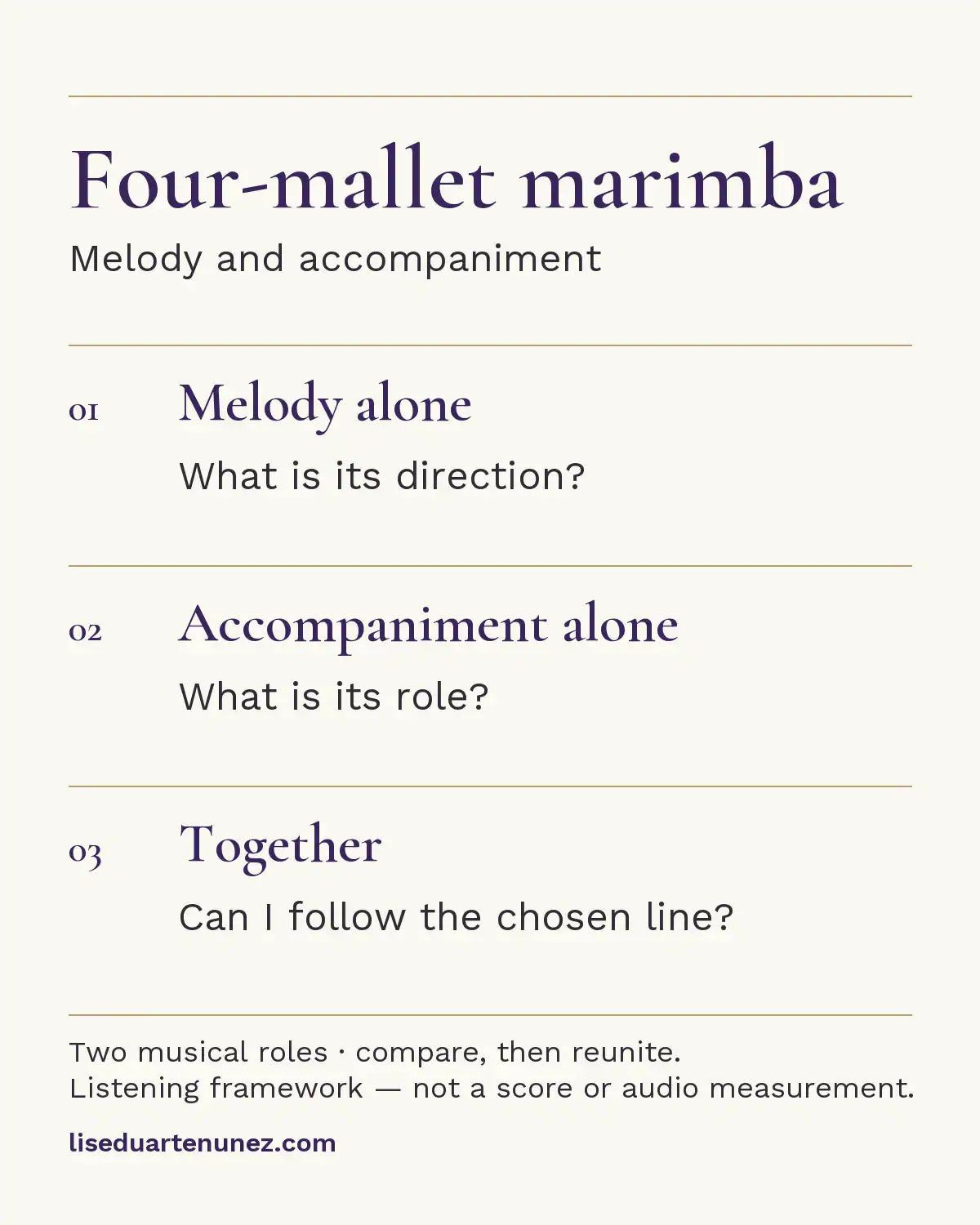
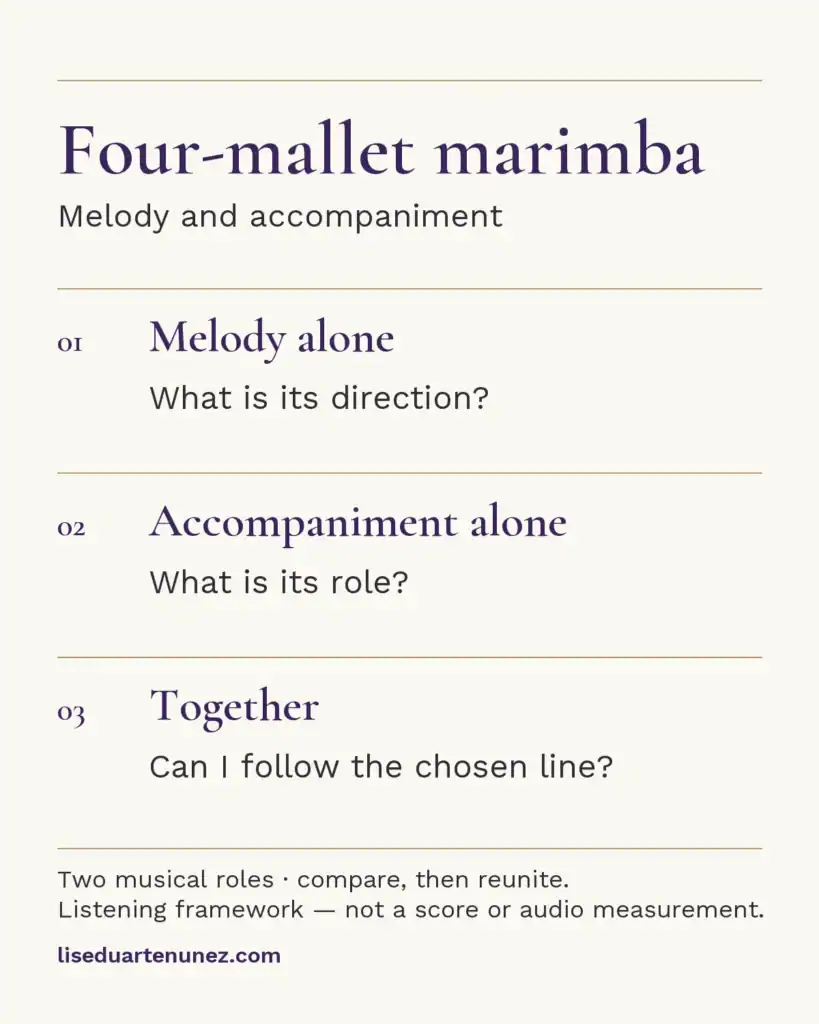
The proposed visual summarises three checks: Melody alone: what is its direction? Accompaniment alone: what is its role? Together: can I follow the chosen line? Read the labels as listening stages, not fixed registers, hands or measured loudness levels. Judge whether the accompaniment masks the line only when the parts are together.
Adjust balance without making everything louder
If the melody becomes less distinct, do not automatically increase the volume of the entire texture. First identify where the difficulty occurs: the first chord, the moving notes or the return to C5.
Try one bounded change. For example, preserve the intended melodic dynamic while reducing the accompaniment’s prominence. Repeat the complete bar and ask whether the melody is easier to follow and the harmony still supports it. If the physical adjustment is unclear, ask your teacher to observe rather than guessing from the sound alone.
| What you notice | What to investigate next |
|---|---|
| The moving notes are clear alone but hard to follow together | Recheck the balance at the same pulse before changing the equipment. |
| One chord attack interrupts the line | Locate that beat and compare its onset with the other attacks. |
| The accompaniment becomes too weak to support the phrase | Restore enough presence to hear its musical role; “less prominent” is not “absent.” |
| The four notes do not arrive together | Reduce the task and ask for help with coordination before drawing conclusions about balance. |
These questions do not identify a universal cause or prescribe a particular wrist or finger action. The desired relationship depends on the music, instrument, room and listener.
Check what the recording can—and cannot—tell you
For a short comparison, keep the microphone or phone in the same position and avoid changing its level between takes. The percussion practice recording guide explains the setup in more detail.
Listen once for the melodic line and once for the supporting harmony. Note any uncertainty instead of treating the recording as a verdict about your technique. A nearby microphone and automatic processing can change the apparent relationship between registers; playback at that position does not establish balance throughout a room.
When possible, ask a teacher or colleague at a useful listening position whether the line you intend to lead remains audible. That is a musical observation, not a calibrated loudness measurement.
Bring the balance back into the phrase
After the short exercise, return to a familiar passage that already uses four mallets. Identify its leading line afresh; do not carry the example’s upper-voice arrangement into music where another voice matters more.
Play from before the difficult moment and continue beyond it. Does the chosen balance support the phrase as it changes, or does the accompaniment become conspicuous at a transition? Keep any simplification temporary: the aim is to restore the written music, not permanently remove its difficult notes.
This is a different question from the West Side Story vibraphone guide, which deals with attack, ringing overlap and pedal decisions. A vibraphone pedalling plan is not a marimba balance instruction.
For individual feedback on a passage or a clearly defined musical question, explore the focused online percussion lessons. You can discuss your project; bookings and payments are not open yet. This article does not announce a separate marimba course or guarantee a particular outcome.
Sources and further reading
- Yamaha, How to Play the Marimba: Various Playing Techniques. Used for the basic four-mallet arrangement, not as a universal grip prescription; consulted 18 October 2026.
- James Walker, Classical Techniques for Jazz Mallets, 1999. Used for its discussion of multiple lines and accompaniment; no score, image or exercise reproduced; consulted 18 October 2026.
- Julia Gaines / Vic Firth, Sequential Studies for 4 Mallet Marimba: Lesson 2. Lesson headings and published series description read; video and book not analysed; consulted 18 October 2026.