A flam can be clear without becoming an accent. That distinction is a useful starting point for Jacques Delécluse’s Étude No. 6 from Douze Études pour Caisse-Claire.
The study brings rudimental detail into a musical phrase. The challenge is to hear the written rhythm and dynamic through the ornaments, while allowing the passage to develop beyond a succession of separate technical events.
You can watch Lise Duarte Nuñez’s 50-second excerpt on Instagram. The questions below provide a way to approach the study with your own score; they are not a transcription or a complete performance analysis of that short video.
Watch the Delécluse excerpt
If the player is blocked by your privacy choices, you can watch this excerpt on YouTube.
Articulation and accent are different decisions
In his study guide to Delécluse’s Twelve Studies, Brian Stackhouse highlights an important detail: the flams in Étude No. 6 are not marked with accents. His discussion of the study appears on pages 62–70, with the flam exercise discussed on page 65.
The grace note still needs to speak. Its presence does not, by itself, instruct the player to increase the volume of the main note. Keep the written dynamics as your reference when deciding how the ornament belongs to the phrase.
Ask two questions separately: can I distinguish the ornament, and can I still hear the intended dynamic shape? A change that improves one may require further work on the other.
Hear the phrase beneath the ornaments
Stackhouse describes the study’s 2/4 metre and its flams, drags and triple-stroke fours in relation to a rudimental character. He also traces the development of the opening material through rhythmic density, syncopation and dynamic contrast. Rather than presenting a simple sequence of unrelated sections, his analysis follows the continuation and transformation of the phrase.
Use that distinction when practising. Before isolating an ornament, identify where the short musical unit begins, where it is moving and how it connects to what follows. Then return the isolated detail to that larger unit.
A listening exercise with two versions
Choose a short phrase from your own copy of the study. This exercise is a teaching adaptation, not an exercise reproduced from the score or from Stackhouse’s guide.
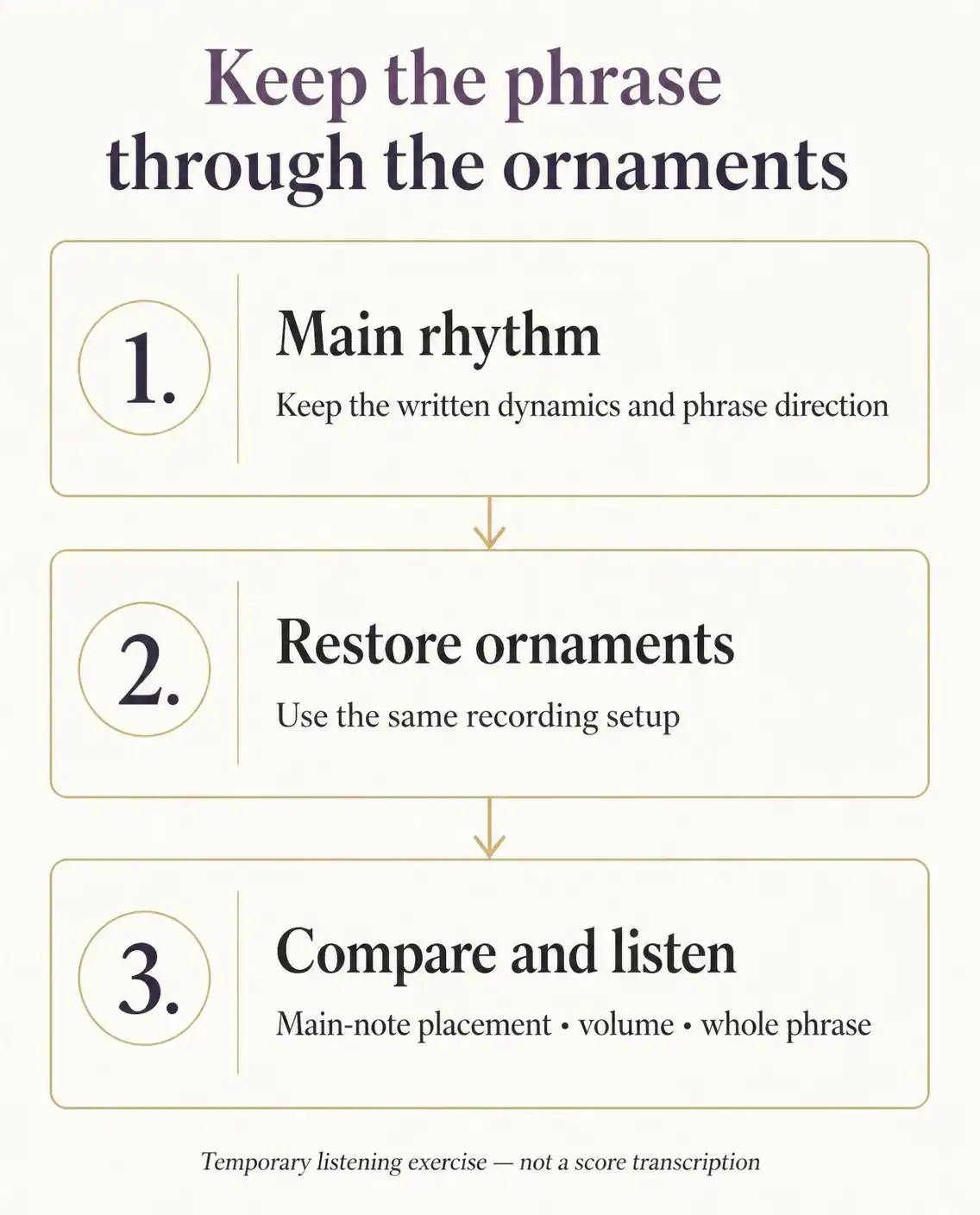
- Play the main rhythm without the grace notes, retaining the written dynamics and phrase direction.
- Record that version at a tempo where you can hear the pulse clearly.
- Restore the ornaments and record again with the same setup.
- Compare the placement and volume of the main notes, then listen to the whole phrase.
The simplified version helps you identify what the ornamented version needs to preserve. It is a temporary diagnostic tool; the grace notes remain part of the final music.
Listen for an unintended emphasis, a main note arriving differently, or a phrase losing direction around a difficult figure. Describe what you hear before deciding why it happened.
Choose one adjustment for the next take
If the main note becomes louder when the flam returns, make that your next listening question. If the volume remains appropriate but the pulse becomes uncertain, work on placement instead. Keep the passage short enough to compare the results attentively.
There is no single sticking prescribed here. A choice must work with the surrounding rhythm, your control at the required dynamic and the musical continuity. A fingering or roll-base suggestion in a study guide remains an interpretive proposal to examine with the score and your teacher.
Carry the result into the complete study
After focused work, play a longer section. Check whether the improvement survives the transition into and out of the phrase. An ornament that works in isolation still needs to belong within the study’s pacing and dynamic range.
This connection between intention, technical choice and audible result is central to MTDM. For a practical way to document your trials, read how to record percussion practice.
For guided work on snare drum interpretation and orchestral percussion, explore working with Lise.