A crash cymbal note has a beginning, a resonance and an end. In an orchestral passage, all three participate in the phrase.
Charles Gounod’s Danse de Phryné, the final number of the ballet music from Faust, offers a useful starting point for thinking about that complete sound. Lise Duarte Nuñez’s Instagram excerpt from the closing passage introduces the question: how long should the resonance live?
The answer depends on what the music is doing around the cymbals. It needs to be prepared through the score and listening, then adjusted to the actual ensemble and acoustic.
Watch the Faust cymbal excerpt
If the player is blocked by your privacy choices, you can watch this video on YouTube.
Where the dance belongs
Faust was first performed at the Théâtre-Lyrique in Paris in 1859. Bru Zane’s history of the work distinguishes that original production from the Paris Opéra version with ballet presented in 1869.
Danse de Phryné is the seventh ballet number, marked Allegro vivo. The Universal Music Group release with the Academy of St Martin in the Fields and Neville Marriner identifies the movement under that title. When preparing an excerpt, check its boundaries in the edition you are using rather than assuming every part uses the same numbering.
This context gives the passage a place in the work. The practical decisions still begin with the details of your part and the orchestral phrase.
Prepare the end as carefully as the attack
Before playing, identify where the cymbal sound begins and what follows it. Is there another attack to clarify, a phrase to sustain or a silence to reveal? Look for explicit note values, rests and instructions, then investigate how they relate to the full score.
A sound can begin at the right moment yet continue across something that needs to be heard. It can also end so abruptly that the phrase loses its sense of continuation. These are questions to assess in context, not reasons to apply the same damping rule to every crash.
Try completing this sentence: “The resonance should continue until…” Your answer gives you a specific musical event or sound to listen for in rehearsal.
Separate three listening questions
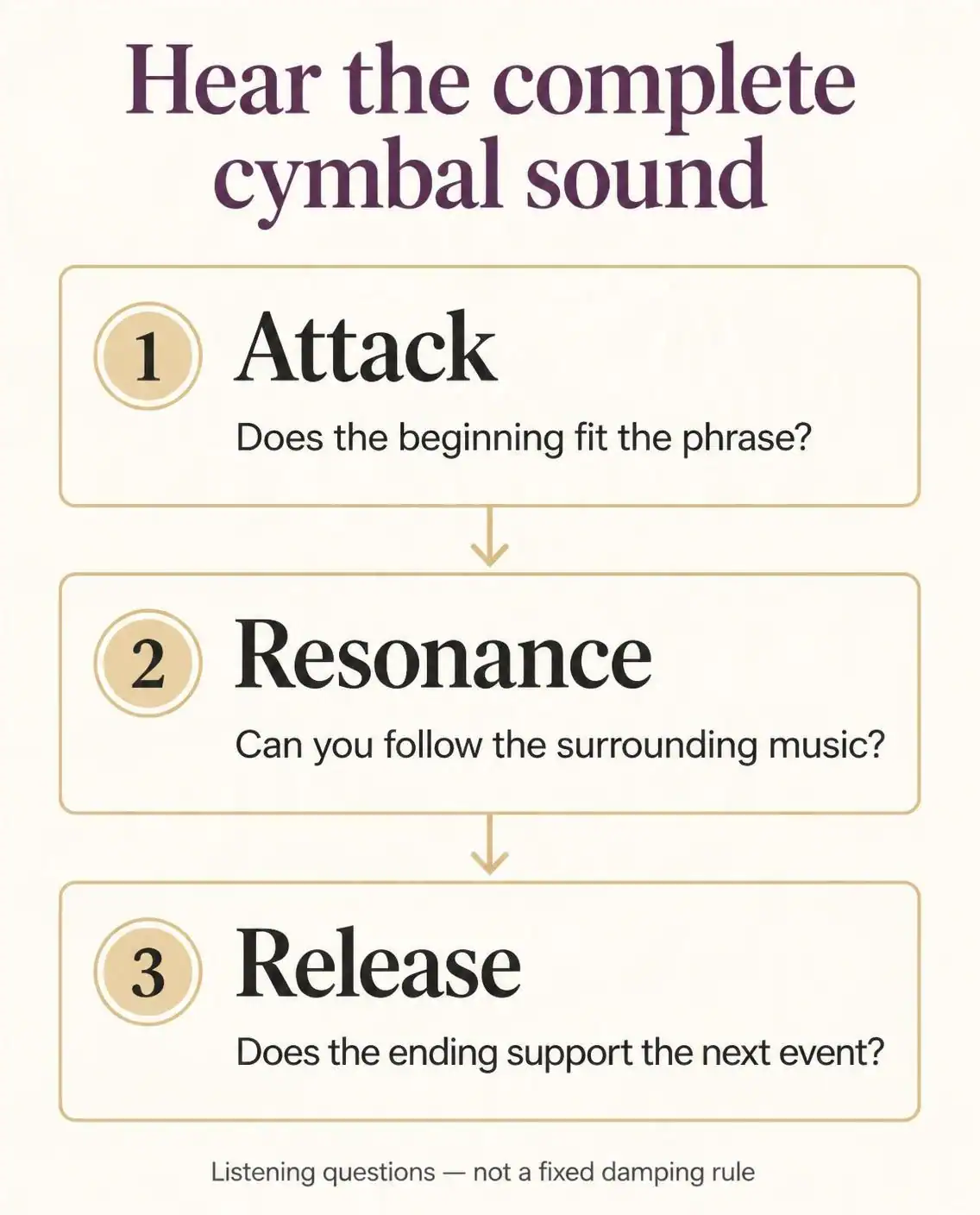
First, listen to the beginning. Does the attack arrive as intended, with the character and balance needed at that point in the phrase?
Next, listen to what remains after the impact. Can you follow the surrounding music while the cymbals resonate? A recording can help you notice the relationship, although its microphone placement will influence the apparent balance.
Finally, listen to the release. Does the end of the sound support the next musical event? Include the movement used to end the resonance in your practice, using an approach you can control comfortably and reliably.
Separating these questions makes it easier to decide what needs work. It does not imply that the three parts of the sound can be separated completely in performance.
A short comparison for the practice room
Choose a manageable phrase from the passage and form a first hypothesis about the duration of the sound. This is a proposed listening exercise, not a damping instruction attributed to Gounod.
- Play and record the phrase, including enough time to hear the end of the resonance.
- Keep the instrument, recording position and intended dynamic consistent.
- Try a different release point while preserving the rest of the phrase as closely as possible.
- Compare how each version connects with the next event.
Write down which version supports your understanding of the phrase and what remains uncertain. If changing the release also changes the attack, acknowledge both differences before drawing a conclusion.
Test the choice with the orchestra
A rehearsal can change your initial decision. The hall, orchestral balance, tempo and conductor’s direction all contribute to what the audience hears. Listen beyond the position where you are standing and seek feedback from an appropriate listening place when possible.
The goal is a sound whose duration has a purpose. That connects the excerpt with sound before gesture and the process of hypothesis, evaluation and adjustment described in MTDM.
For guided work on orchestral accessories and interpretation, explore masterclasses and workshops with Lise.