A tambourine roll needs a beginning, a continuing sound and an ending that belong to the phrase. Choosing a technique means deciding how to produce those three things in the passage you are preparing.
A familiar technique gives you a starting point. To decide whether it serves the music, listen beyond whether the jingles keep moving. Does the sound have the intended character? Can you begin without an unwanted accent? Can you finish where the phrase needs you to?
The following comparison is a proposed practice protocol. It contains no personal test results and can be adapted with your teacher.
Watch: tambourine support and angle
If the player is blocked by your privacy choices, you can watch this video on YouTube.
Identify the options without turning them into rules
Sean Rode’s Accessory Percussion in the Practice Room, published by the Percussive Arts Society, identifies shake rolls and thumb/finger rolls among the techniques percussionists should practise.
In a shake roll, movement of the instrument keeps the jingles sounding. A thumb or finger friction roll uses contact with the head to sustain their activity. Black Swamp’s discussion of three tambourine roll techniques, presenting Gerardo Capaldo’s approach, also includes alternating finger strokes and connects technique selection with musical character and dynamics.
Those resources offer approaches to explore. They do not make a dynamic marking an automatic instruction to use one technique. Your instrument, the passage and your present control still need testing.
Describe the complete sound
Before playing, write one sentence about the result. Include the attack, the sustained sound and the release.
For example, imagine this fictional practice situation: a quiet roll supports a continuing phrase, grows slightly, then stops before a new texture begins. This is an invented exercise, not a description of a particular orchestral work.
Your intention might be: “The roll should enter without a separate accent, remain continuous through the growth and leave a clearly audible silence.”
The sequence in How to Prepare an Orchestral Percussion Entrance can help you establish the musical context. Here, the specific question is which roll technique can realise that intention.
Try a phrase, then compare a second solution
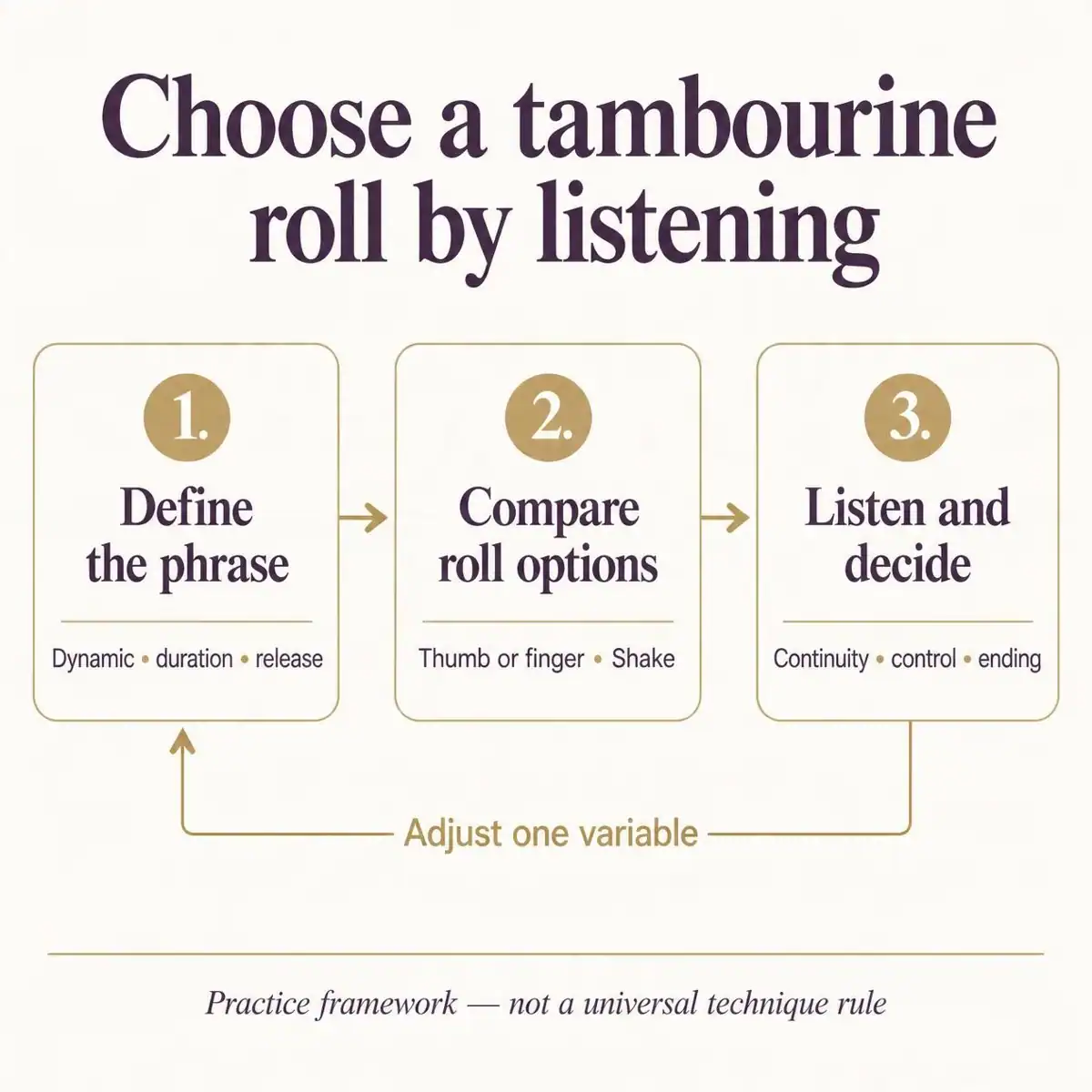
- Define the boundaries. Choose a short phrase, its tempo, dynamic shape and intended stopping point. Include preparation before the roll and silence afterwards.
- Document the conditions. Note the tambourine, head, room and technique. Keep the instrument and listening position consistent between trials.
- Play the first solution. Use a technique you can already perform securely. Complete the phrase before judging it.
- Try the alternative. Keep the musical task the same. Do not force an unfamiliar technique simply to complete the comparison; work on its basics separately with your teacher if necessary.
- Return to the first solution. An A–B–A sequence gives you another opportunity to check your initial impression. It does not eliminate differences between performances.
- Listen and choose a next test. Identify one audible difference before proposing an explanation.
If you record the trials, follow the consistent setup described in How to Record Percussion Practice. A change in microphone position or automatic level adjustment can complicate comparisons.
Use a blank observation sheet
Complete this sheet after listening. The empty cells deliberately contain no predicted results.
| Listening point | First solution | Alternative | Next test |
|---|---|---|---|
| Beginning: accent, delay or intended onset? | |||
| Continuity: gaps or unwanted pulses? | |||
| Shape: does the phrase develop as intended? | |||
| Release: does the sound end where needed? |
Keep observation separate from cause. “A gap occurs before the release” describes something to locate and check. “This technique cannot work” reaches much further than one trial supports.
You may choose one solution for the passage, or discover that neither yet meets the intention. In that case, narrow the next task: work on the onset, continuity or ending separately, then restore the whole phrase. This connects with evaluation and adjustment in MTDM.
Short FAQ
Is a thumb roll always the right choice for quiet playing?
Treat it as an option to test. Check the actual onset, continuity and release on your instrument rather than deciding from the dynamic marking alone.
Should I change technique during a roll?
Only if the passage needs it and the transition serves the sound. Practise the change itself, then listen to it within the complete phrase.
What if the comparison is inconclusive?
Ask a listener one specific question, or reduce the task to the unclear detail. Keep the uncertainty in your notes instead of inventing a winner.