Choosing a triangle beater starts with a musical question: what should this sound contribute to the passage? An attack may need definition, a resonance may need room to continue, or a short note may need a carefully controlled ending.
The beater belongs within that decision. To compare two options meaningfully, give them the same musical task and listen to the whole result. A description such as “clearer” becomes useful when you can identify what became clearer and why it matters.
This article proposes a comparison you can carry out. It reports no personal equipment test or preferred product.
Watch the triangle demonstration
If the player is blocked by your privacy choices, you can watch this video on YouTube.
Separate the beater from the rest of the setup
Vic Firth’s Percussion 101 triangle resource treats beater selection alongside suspension, striking techniques, muffling and rolls. Its study questions explicitly ask whether an assortment of beaters is useful. These are connected decisions to investigate, rather than a single specification that settles every passage.
Before comparing, document the triangle and its suspension. Check that the instrument is securely supported and that unintended contact is not shortening the sound. Keep the playing area, intended dynamic and listening position as consistent as practical.
If you change your grip, angle or striking position substantially to use a different beater, note that. You are then comparing two playing solutions, not isolating the beater alone.
Give both options a specific task
Start from a passage you are authorised to use, or make a short exercise of your own. Read any indications about articulation, duration and damping before deciding what to test.
Here is a fictional practice example: a short triangle pattern leads into a sustained note, followed by a deliberate release. The task is to make the pattern distinct while allowing the final resonance to continue until the chosen ending. This is not an excerpt from an orchestral score.
Write the intended result before choosing between beaters. The broader preparation process is explained in How to Prepare an Orchestral Percussion Entrance; the comparison here focuses specifically on the playing implement.
Run a comparison in two stages
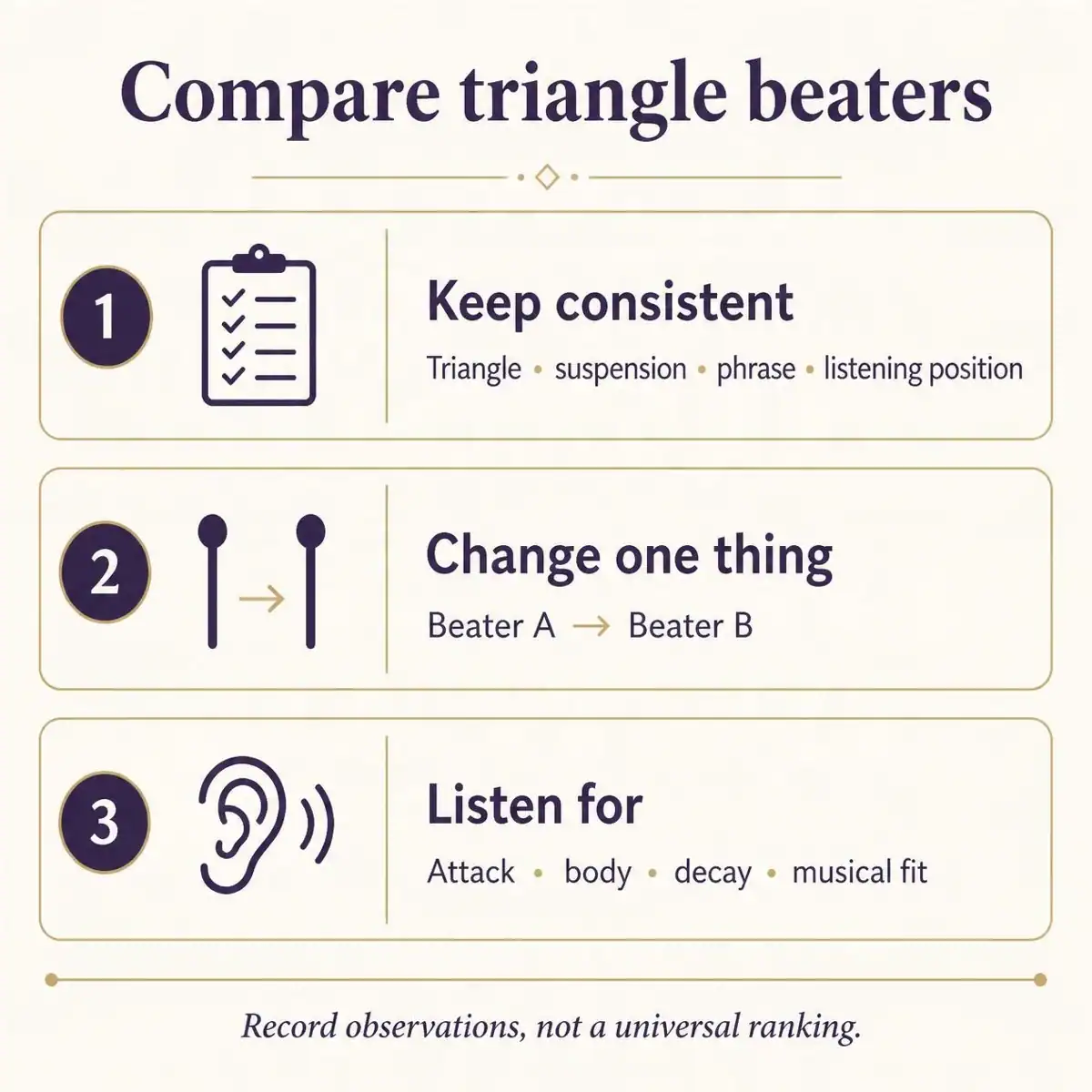
- Label the options A and B. Record enough information to identify each beater later. Do not assign a predicted winner.
- Play the complete exercise with A. Include preparation, the pattern, the sustained note and the release.
- Repeat with B. Keep the task and setup consistent. Listen for differences without immediately compensating by changing several other variables.
- Repeat in reverse order. Begin with B, then return to A. Note whether your impression remains stable.
- Test adaptation separately. Now allow yourself to adjust the playing approach for each beater. Document those adjustments and ask which complete solution serves the phrase.
- Choose provisionally. Take the preferred solution into the relevant rehearsal context when possible.
The first stage limits changes; the second explores what you can achieve through adaptation. Neither is a controlled laboratory experiment. This distinction also matters when comparing drumstick tip shapes: changing a complete implement can change more than one feature.
Listen beyond the first contact
Use this blank observation sheet. Fill the cells with what you actually hear, including uncertainty.
| Criterion | Option A | Option B | Question still open |
|---|---|---|---|
| Definition of the short pattern | |||
| Character of the sustained note | |||
| Continuity into the release | |||
| Unintended contact or extra sounds |
Avoid turning one impression into a universal claim about material or diameter. The conclusion should describe this instrument, task and playing approach.
If the passage includes a roll, test that separately before repeating the phrase. Sean Rode’s PAS practice article includes triangle roll and release work, supporting the need to practise more than isolated attacks.
A recording can help you revisit detail, but one microphone position does not establish balance throughout a hall. Use the setup guidance in How to Record Percussion Practice and seek an appropriate listening perspective when ensemble balance remains unresolved.
Short FAQ
Does a thicker beater always produce the sound I need?
Diameter alone cannot settle the musical choice. Compare the actual implements on your triangle and describe the result rather than predicting it from one dimension.
Should I test rolls as well as single notes?
Yes, when the passage requires both. A choice that suits isolated attacks still needs checking through the roll and its ending.
What if the two beaters both work?
Keep both as viable options. Document the conditions and choose for the actual phrase, acoustic and ensemble, rather than manufacturing a permanent ranking.