The five common drumstick tip shapes are round (ball), oval (olive), teardrop, acorn and barrel. Their profiles change the contact with a cymbal, influencing attack, stick definition and wash. Wood or nylon changes the contact material; it is a separate choice from the tip shape.
The tip — or bead — is the part of the drumstick that first meets the cymbal or drumhead. Its shape and material influence the contact, the initial attack and the way the sound opens into ping and wash. But no tip has a fixed sound by itself. The cymbal, the stroke, the angle, the stick’s mass and the player’s intention all matter.
This is why choosing a drumstick tip is not simply a question of finding the shape with the most attractive description. A round tip is not automatically bright. An acorn tip is not automatically dark. An oval tip does not have one single sound.
The useful question is more specific:
What kind of contact do I want to create, and what does the music need from that contact?
In this guide, we will compare the main drumstick tip types and shapes — round, oval, teardrop, acorn and barrel — and look at what changes when the tip is made of wood or nylon. The goal is not to find a universally “best” tip, but to understand which variable you are changing and how to listen for the result.
For a quick comparison, go to the drumstick tip shapes chart. To compare materials, start with wood vs nylon tips or how the stick’s wood affects playing feel.
The tip as an interface
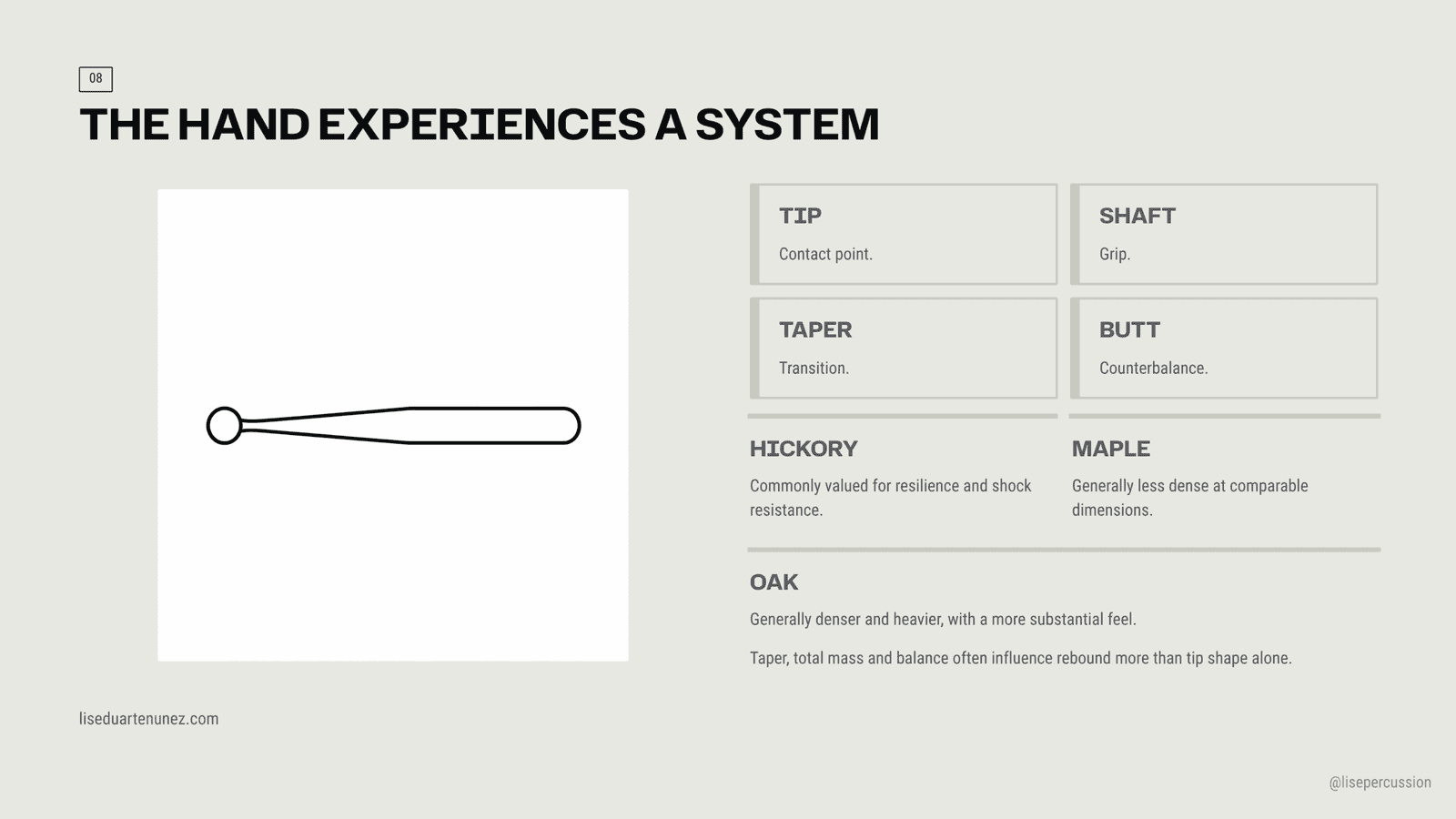
A drumstick can be divided into several functional areas: the butt, the shaft, the taper or shoulder, and the tip. Each part influences the way the stick moves and responds.
The shaft and taper affect the stick’s balance, flexibility, rebound and overall feel. The tip is different. It is the part that directly meets the instrument, which makes it especially important for the beginning of a cymbal sound.
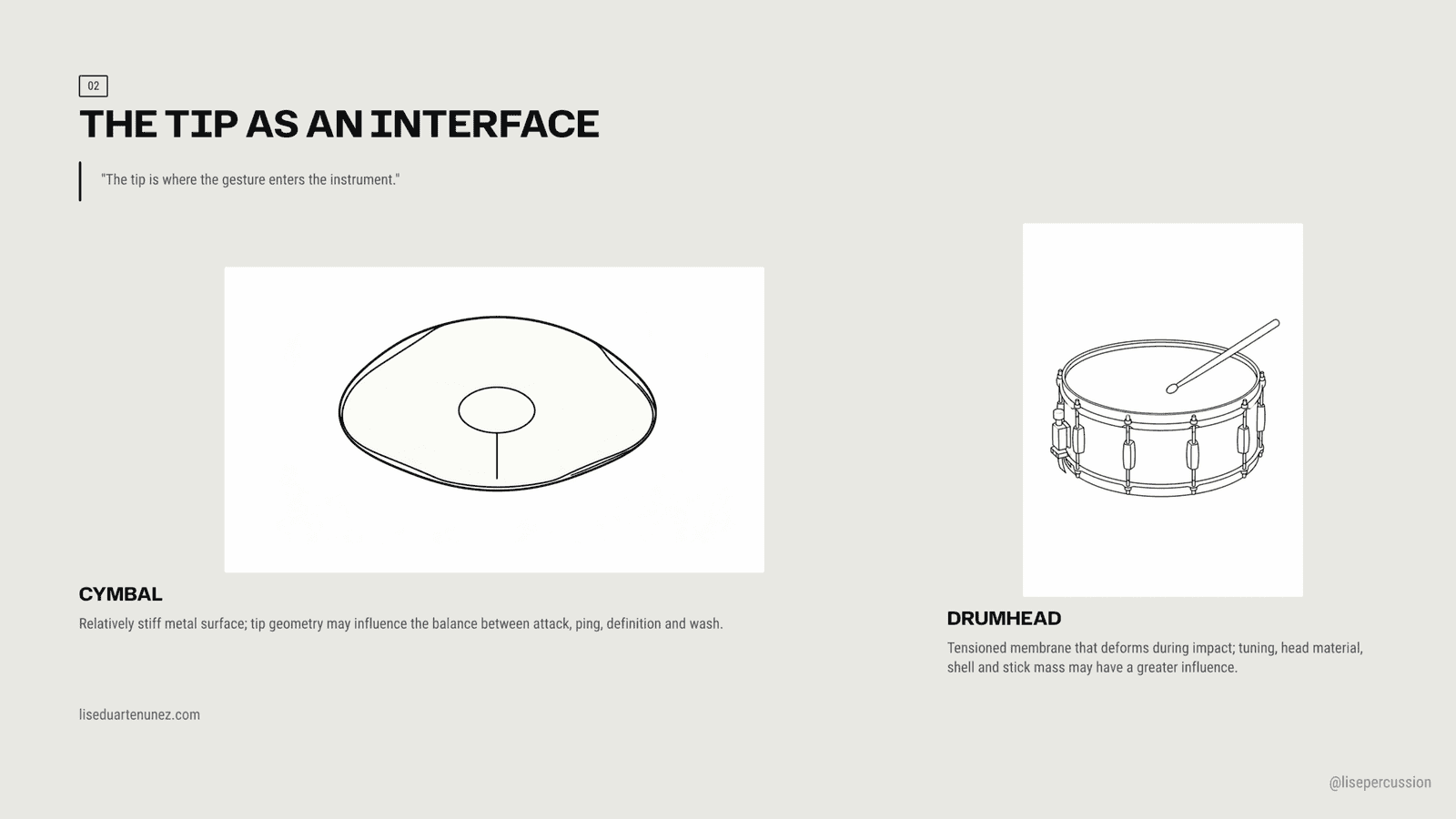
A cymbal is a stiff metal plate that responds to the energy of the impact through many modes of vibration. A drumhead behaves differently: it is a tensioned membrane that deforms during the stroke. The interaction between the stick and the instrument is therefore not the same in both cases.
On a cymbal, changes in contact geometry can be particularly noticeable in the relationship between the initial attack and the longer sound that follows. We may hear this relationship as ping, definition, wash, body or openness.
On a drumhead, the influence of the tip is usually less isolated. Tuning, head material, shell construction, playing position, dynamic level and stick mass often have a greater effect on the result. Research and teaching models of drum acoustics also show how strongly tension, material and strike position shape the response of a tensioned membrane.
The tip is therefore best understood as an interface. It is where the gesture enters the instrument.
The main drumstick tip shapes
There is no universal naming system across manufacturers. The same general geometry may receive slightly different names, and two tips with the same name may not have exactly the same dimensions. The categories below should be understood as families of shapes rather than rigid standards — together, they cover most of the drumstick tip types you will encounter.
Size matters within each family. For example, Meinl’s manufacturer tip comparison distinguishes small, standard and large acorn profiles, as well as a hybrid. A shape name alone is not enough to predict the sound of two complete sticks.
Tip shape is not stick size. Labels such as 7A, 5A and 5B identify stick size or model families, not round, oval or acorn tips. For example, ProMark’s drumstick guide distinguishes a lighter, slimmer 7A, a medium 5A and a heavier, wider 5B. Check the actual model’s diameter, taper and tip specifications rather than assuming the size label determines its bead.
Every shape changes one thing first: the geometry of the contact — how much surface meets the cymbal, for how long, and how that contact shifts as the angle changes.
Round or ball tip
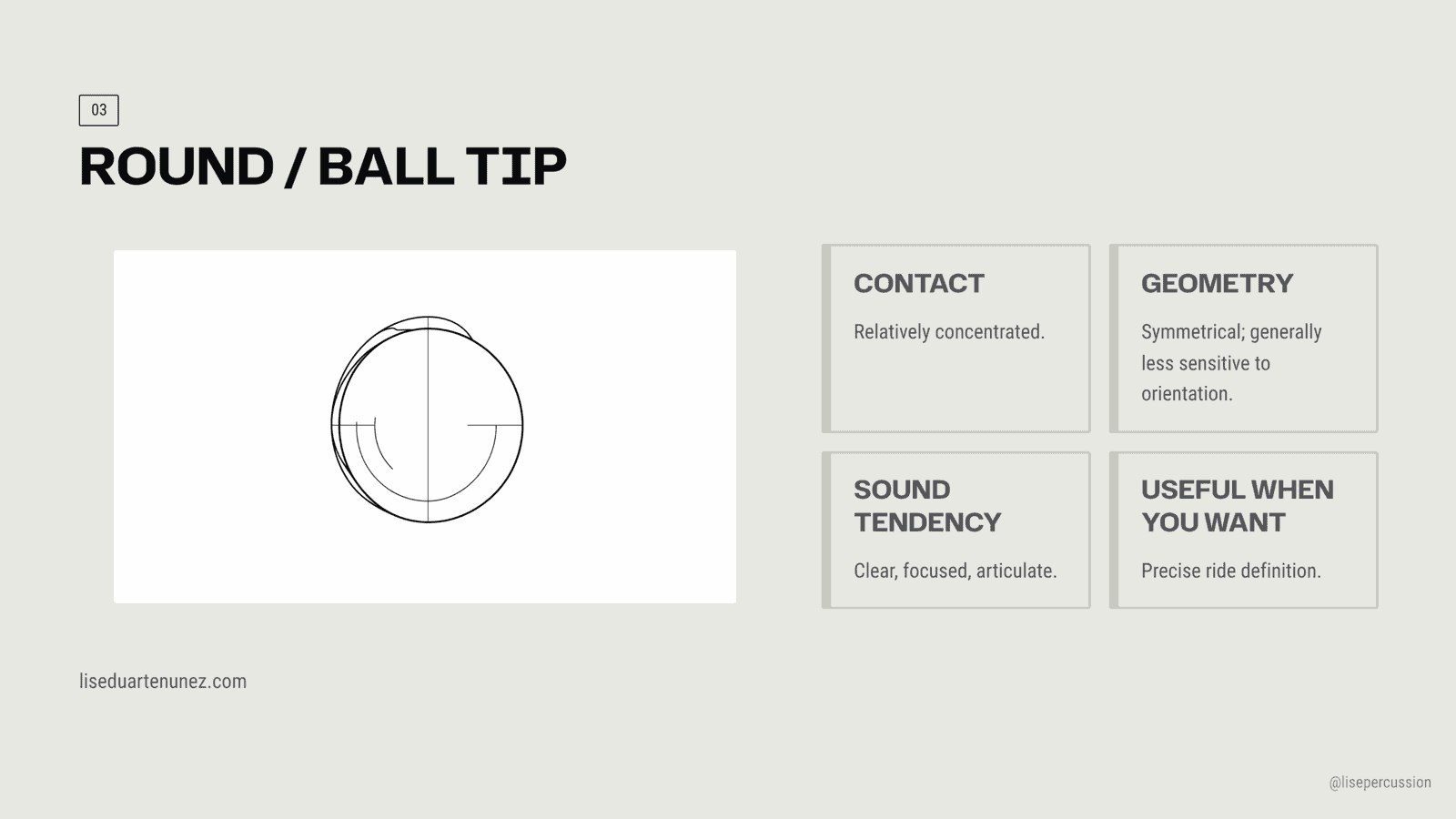
A round tip presents a relatively concentrated contact on a hard cymbal surface. Because its geometry is symmetrical, it is generally less sensitive to orientation than an elongated tip, although the angle and force of the stroke still matter.
This can make a round tip useful when you want a clear, focused cymbal attack and a precise sense of stick definition.
Typical tendencies include:
- a concentrated contact;
- a clear and precise initial attack;
- a focused sense of ping;
- relatively stable articulation as the stick rotates;
- a direct response on the ride cymbal.
These are tendencies, not guarantees. A round tip on a dark, complex ride may still produce a darker sound than a larger tip on a bright, highly projecting cymbal.
The round profile is especially interesting when you want to hear the cymbal clearly without adding too much surface area to the contact. It can help the stroke speak with precision.
Oval or olive tip
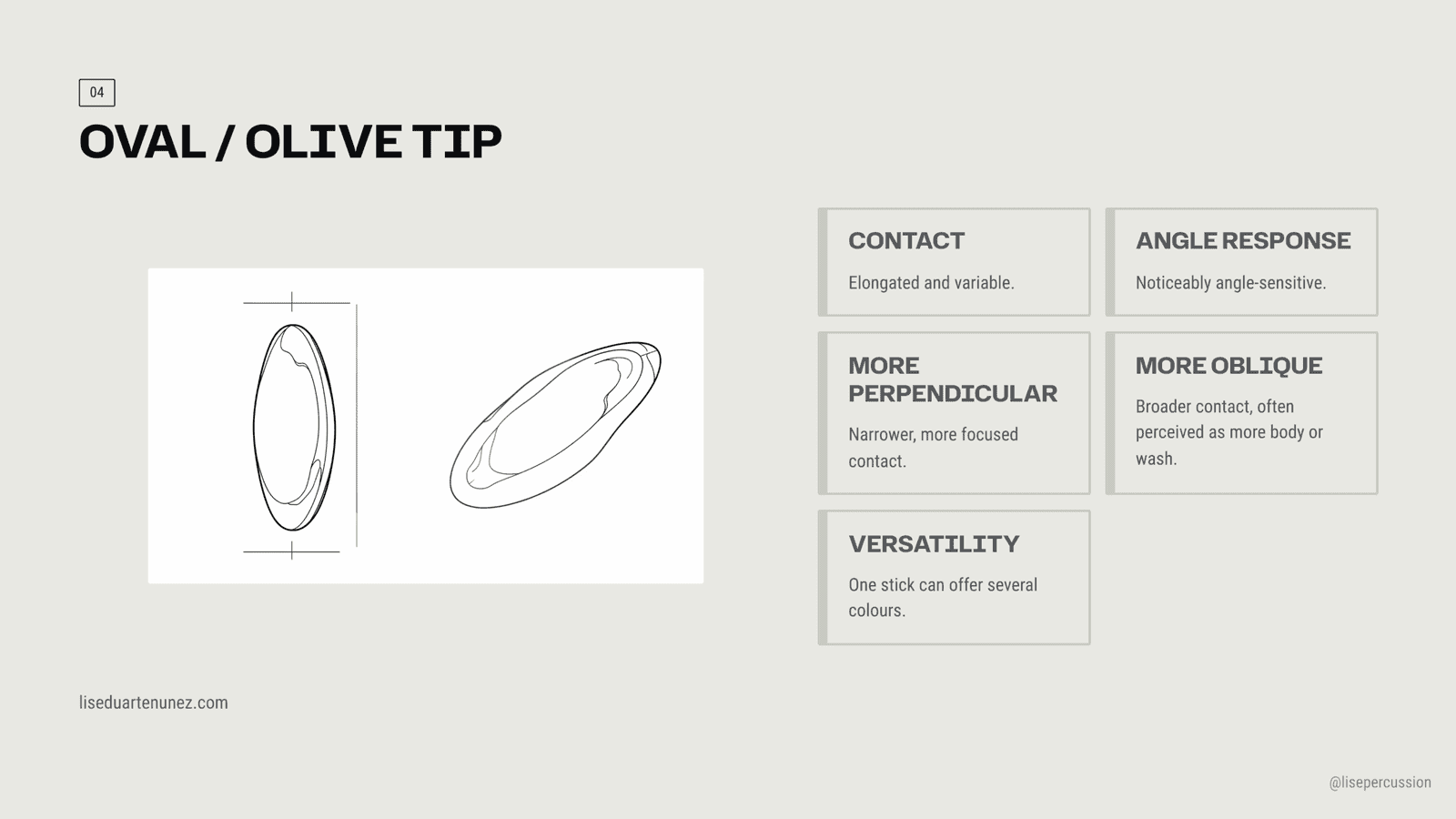
An oval, sometimes called an olive, is elongated rather than symmetrical. Its contact changes more noticeably with the angle at which the stick meets the cymbal.
When the narrower end of the oval makes contact, the attack can feel more concentrated. When the stroke allows more of the side of the oval to engage, the contact becomes broader and the response may feel fuller or less sharply focused.
Typical tendencies include:
- a medium to relatively broad contact, depending on the stroke;
- greater sensitivity to striking angle;
- a balanced relationship between definition and body;
- more variation in colour than a small round tip;
- a versatile response across different playing situations.
The oval tip is valuable because it does not force the player into one sound. The same stick can respond differently when the gesture changes.
This is not a magic warm setting. It is an invitation to listen more closely to the relationship between angle, contact and sound.
Teardrop tip
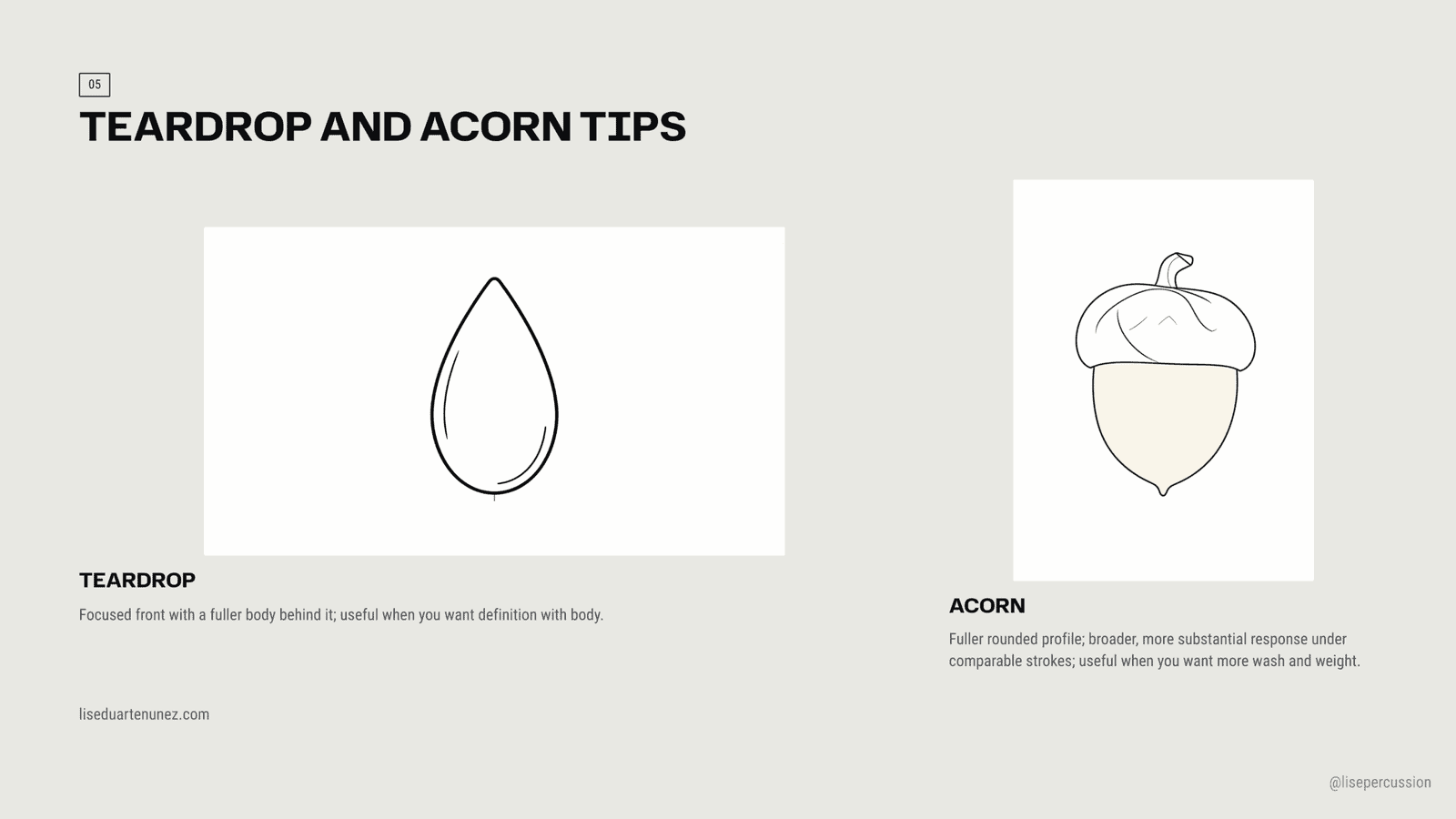
The teardrop shape combines a relatively focused front with a fuller body behind it. It often offers a middle ground between the concentrated articulation of a small tip and the broader response of a larger profile.
Typical tendencies include:
- a defined but not overly narrow contact;
- a rich cymbal response;
- a balance between articulation and warmth;
- enough body to let the cymbal open without losing clarity.
A medium-sized wood stick with a teardrop tip can be a useful starting point for a player who wants definition without an excessively pointed sound. However, the final result still depends on the dimensions of the entire stick. The taper and balance may be as important as the bead itself.
Acorn tip
The acorn has a fuller, rounded profile. Under comparable strokes, more of its surface may engage with the cymbal than with a small round tip.
The result is often perceived as broad, full or fat, with more body and wash and less of the pinpoint quality associated with a small, concentrated contact.
Typical tendencies include:
- a fuller contact geometry;
- a broad initial response;
- a substantial sense of body;
- less sharply focused definition than a small round tip;
- a strong capacity to open a cymbal sound.
The acorn can be useful when the cymbal needs more weight in the sound. But a large profile is not automatically the right answer. If the cymbal already has a lot of low-frequency energy or wash, a smaller tip may provide the clarity that allows the instrument to speak more freely.
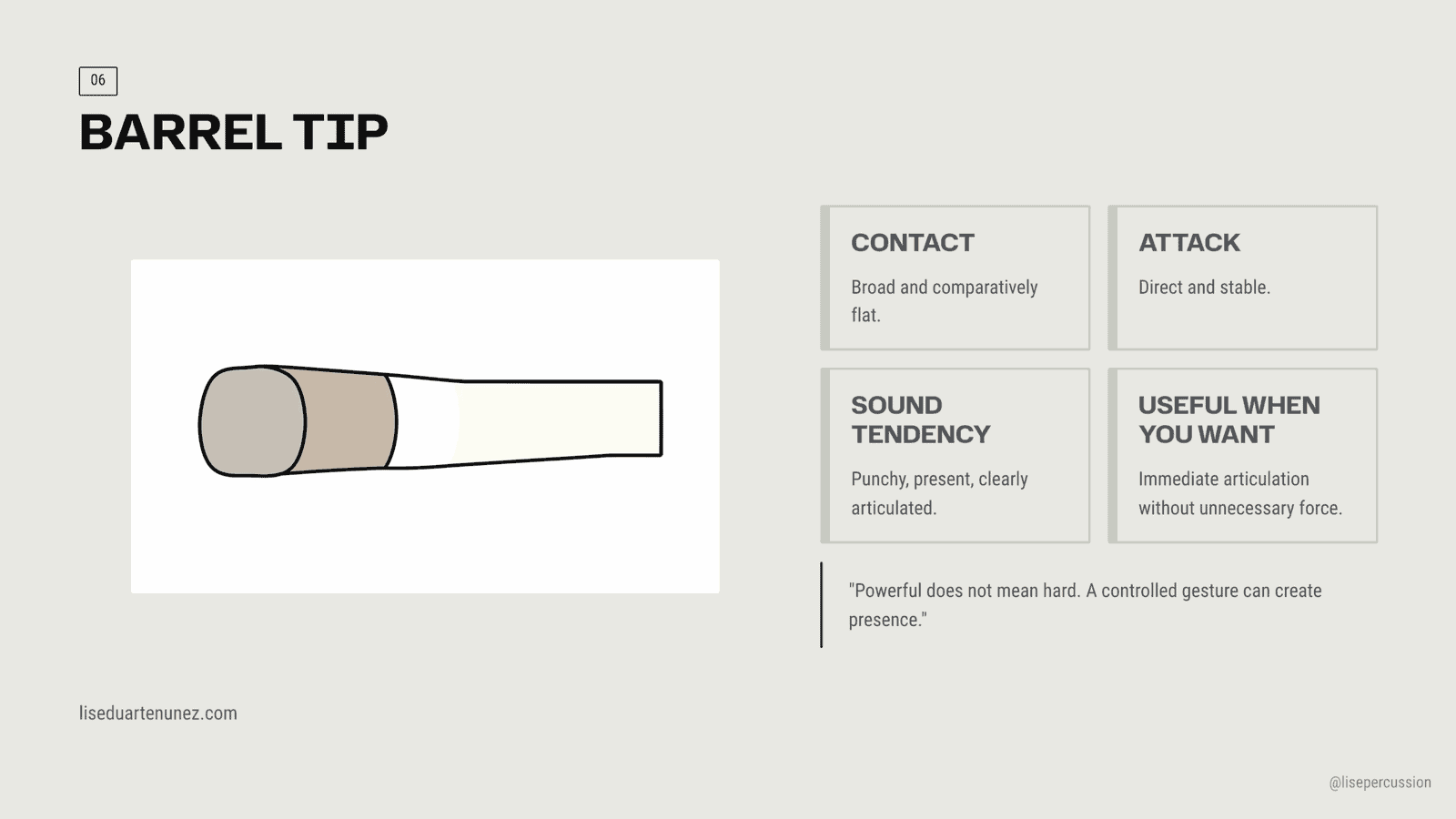
Barrel tip
A barrel tip has a short, relatively broad profile; its exact contour depends on the model. It can provide a direct, defined attack, but the name does not guarantee a flat contact surface or a brighter sound. Meinl, for example, describes its barrel tips in terms of woody definition and fewer mid-range overtones than its traditional round tips.
Typical tendencies include:
- a broad and relatively stable contact;
- a direct, solid attack;
- clear articulation;
- a powerful sense of impact;
- less variation in contact geometry than an elongated oval profile.
The barrel shape can be useful when you want the stroke to feel immediate and present. As with every shape, however, the result is shaped by the cymbal and by the player’s touch. “Powerful” does not have to mean “hard.” A controlled gesture can create presence without unnecessary force.
Shape and sound: tendencies, not laws
It is tempting to build a simple chart: small tip equals bright; large tip equals dark; round tip equals ping; oval tip equals warmth. This is useful as a first orientation, but it becomes misleading when treated as a rule.
So what actually determines the sound? The interaction of several variables:
| Variable | What it changes |
|---|---|
| Tip shape | The geometry and distribution of contact |
| Tip material | The resilience, wear and surface behaviour of the contact point |
| Stick mass | The amount of energy and the feeling of the front end |
| Taper | Flexibility, rebound and balance |
| Striking angle | The portion of the tip that engages the instrument |
| Playing position | The part of the cymbal or head that is activated |
| Dynamic level | The energy and duration of the impact |
| Instrument | The material, tension, thickness and existing voice of the cymbal or drum |
The cymbal is not a neutral surface. Its size, thickness, profile, alloy, lathing, age and playing history all contribute to its response. A tip can influence the beginning of the sound, but it cannot replace the voice of the instrument.
The most accurate language is therefore often the simplest: this tip tends to make this kind of contact easier.
Wood or nylon: what changes?
Tip shape is only half of the story. The material at the contact point also matters.
Wood tips
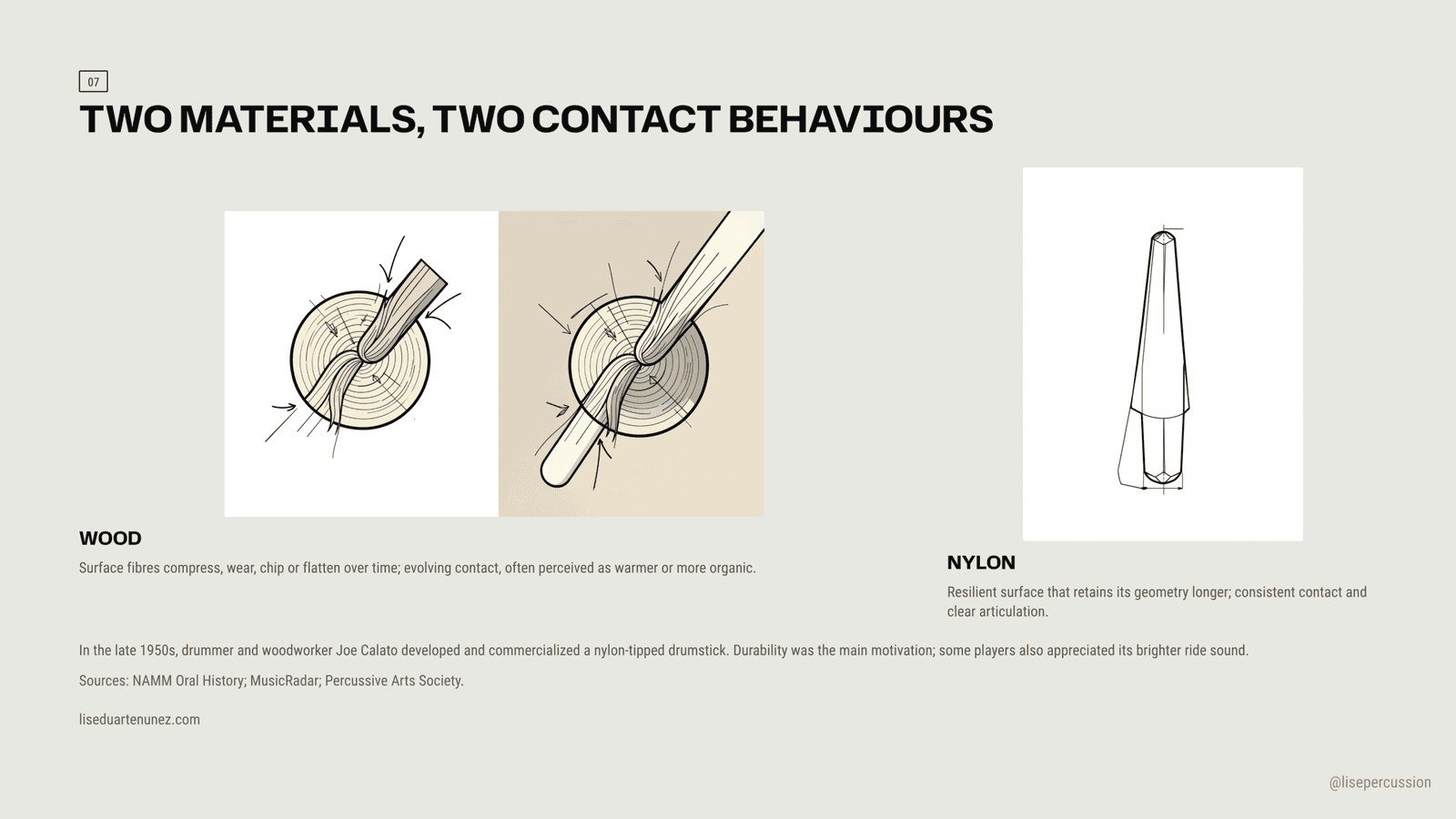
A wood tip is part of the wooden stick itself. With repeated impacts, the fibres at the surface can compress, wear and eventually chip or flatten.
Many players perceive wood as producing a warmer, more organic or more integrated response, particularly on cymbals. It is better to describe this as a difference in contact behaviour and perception than as a single “warm frequency” belonging to wood.
The condition of the tip matters. A new wood tip and a damaged wood tip are not the same tool. Once the surface becomes chipped or flattened, the contact geometry changes. The sound may become less predictable, and the damaged area may also affect the consistency of the stroke.
This is not necessarily a reason to reject wood. Wear is part of the life of the instrument. It simply means that the sound and the tool evolve together.
Nylon tips
In the late 1950s, drummer and woodworker Joe Calato developed and commercialized a nylon-tipped drumstick. According to historical accounts, durability was the main motivation: ride playing was wearing down wooden tips, and nylon offered a more resilient alternative. A brighter ride-cymbal sound was also appreciated by some players.
Nylon is generally more resistant to the chipping associated with wooden tips and tends to retain its geometry for longer. Players often associate it with:
- a clear and immediate cymbal articulation;
- consistent contact over time;
- greater resistance to wooden-tip wear;
- a defined sense of stick sound.
Nylon is not indestructible. It can crack, detach or wear, especially under demanding playing conditions. Nor will every nylon tip sound brighter than every wood tip. Shape, mass, cymbal, dynamic level and technique remain part of the equation.
A useful comparison is to try wood and nylon versions of a similar stick while keeping the dimensions as close as possible. The purpose is not to confirm a slogan. It is to hear what changes for you.
The angle of attack: one oval, several possibilities
The oval tip makes the role of angle especially easy to observe.
Imagine approaching the ride more perpendicularly, with the narrower end of the oval making contact. The contact is relatively concentrated, and the attack may feel more defined.
Now change the angle so that more of the side of the oval meets the cymbal. The contact becomes broader. The beginning of the sound may feel less pointed, with more body or wash in the result.
The important point is not to memorize a formula. It is to notice the connection between the gesture and the sound.
The sound is not produced by the tip alone. It is produced by the meeting between the tip, the cymbal and the gesture.
This is why two players can use the same stick and produce different results. It is also why the same player can find several colours in one stick during a single phrase.
How drumstick materials affect playing experience
It is easy to focus on the bead and forget that the rest of the stick is still present.
Separate the wood of the stick from the material of the tip. A hickory stick can have a wood or nylon tip. Changing the wood can change weight and feel at a similar diameter; changing the tip material changes the surface that meets the instrument. Neither comparison isolates shape unless the other specifications remain comparable.
The wood species, diameter, length, taper and finish influence the stick’s mass, flexibility, balance and mechanical behaviour. These factors change how the stick moves in the hand and how easily it rebounds.
Hickory is commonly valued for its combination of resilience and shock resistance. Maple is generally less dense than hickory at comparable dimensions, which can make a larger stick feel physically substantial without the same mass. Oak is generally denser and heavier, which can produce a more substantial feeling but may also transmit more impact to the hands.
These are general tendencies, not guarantees. Wood varies. Manufacturing varies. Two sticks with the same printed size may still differ in weight and balance.
In its guide to drumstick wood types, Meinl presents hickory as a resilient option and maple as a way to keep a familiar diameter with less weight. Treat that as a starting point, not a promise: compare the actual pair in your hand and listen at your intended dynamic.
The tip shape alone does not determine rebound. Taper, total mass, balance and technique usually have a greater influence. A small tip may contribute to a lighter-feeling front end, but a different taper can change the feeling much more dramatically than the bead profile alone.
The hand does not experience isolated specifications. It experiences a system.
Drumstick tip shapes at a glance
| Tip shape | Contact tendency | Common perceptual tendency | Useful when you want… |
|---|---|---|---|
| Round / ball | Relatively concentrated | Clear, focused, articulate | Precise ride definition |
| Oval / olive | Variable and angle-sensitive | Balanced, adaptable, sometimes broader | Several colours from one stick |
| Teardrop | Focused front with fuller body | Rich, defined, moderately warm | Definition with body |
| Acorn | Fuller rounded profile | Broad, full, substantial | More wash and weight |
| Barrel | Broad and relatively stable | Direct, punchy, present | Immediate articulation |
These are tendencies, not laws. The instrument and the gesture shape the final result.
Which tip should you try?
Begin with the sound you are trying to control rather than with a label.
If you are looking for a concentrated, clearly articulated ride sound, a small round tip may be a useful place to begin. If you want a balance between definition and body, an oval or teardrop can offer more variation. If the cymbal needs a broader and fuller response, an acorn may be worth exploring. If you want a direct, stable attack, a barrel may provide the sense of presence you are looking for.
For a more traditional and evolving contact, try wood. For durability and a more consistent surface over time, try nylon. If the music requires both qualities, compare the two materials on the same cymbal rather than relying on a general description.
For maximum clarity during the experiment, keep the rest of the stick as similar as possible. Compare three profiles with a familiar diameter and approximate weight. Change one variable at a time.
The goal is not to collect more equipment. The goal is to hear more precisely.
A simple listening experiment
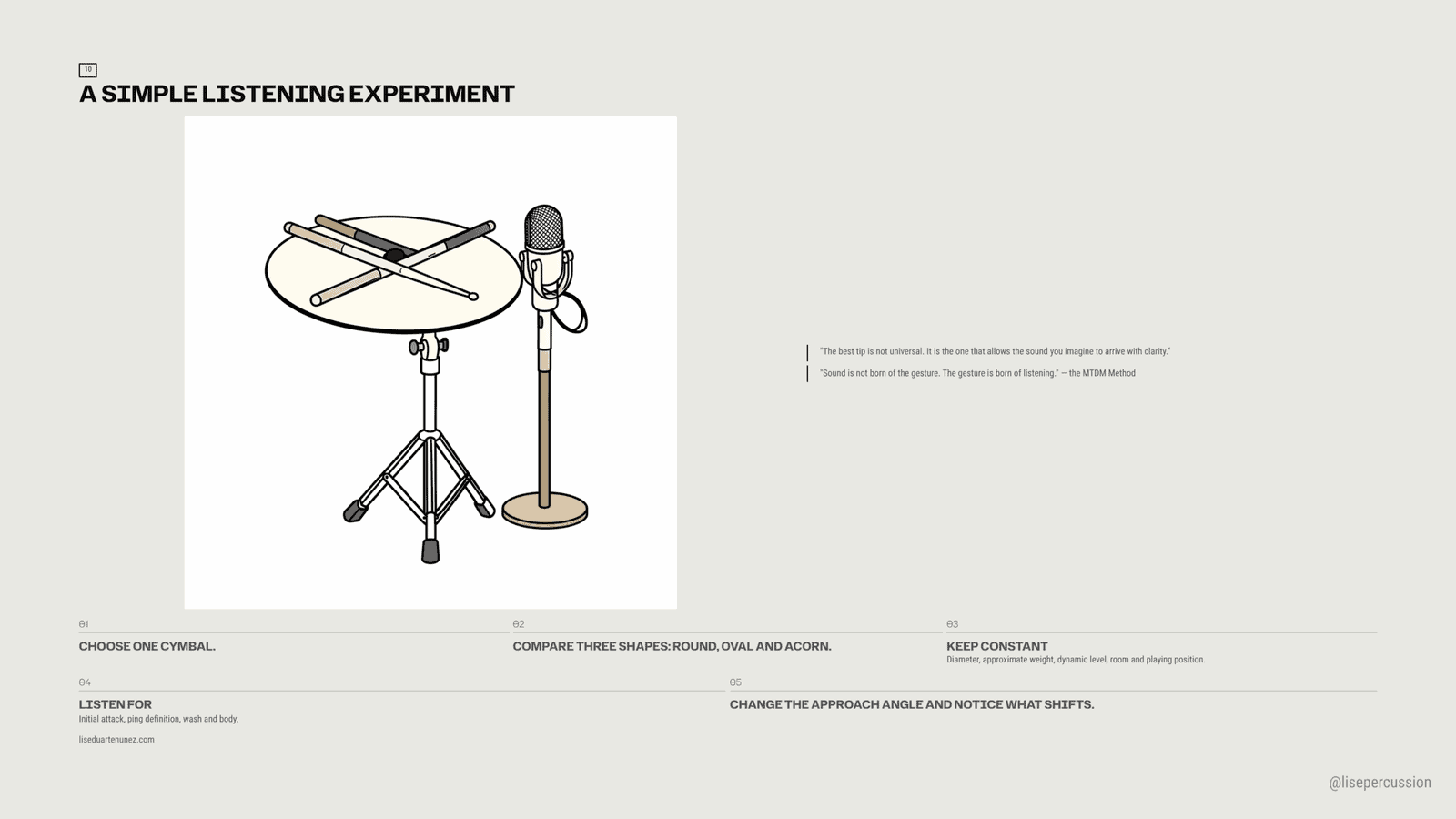
Take the same cymbal and compare three tip shapes. A round, an oval and an acorn make a useful starting group.
Keep as many variables constant as possible:
- Use the same cymbal.
- Play in the same position.
- Keep the stick diameter and approximate weight similar.
- Stay in the same room, or record in the same space.
- Repeat the same dynamic level.
- Use the same basic stroke.
- Change only the tip shape when possible.
Then listen for the beginning of the sound before listening to the whole sound. Notice:
- the clarity of the initial attack;
- the definition of the ping;
- the amount of wash;
- how quickly the cymbal opens;
- how much body remains after the attack;
- how the sound changes when you alter the angle.
If you can record the comparison, do so. The microphone will not tell you what you like, but it can help you hear differences that disappear when memory compares one sound with another.
You may discover that the “warmest” tip is not the one you prefer. You may discover that the most useful stick is not the one with the most obvious character, but the one that gives you the greatest range of expression.
Recording a useful A/B comparison
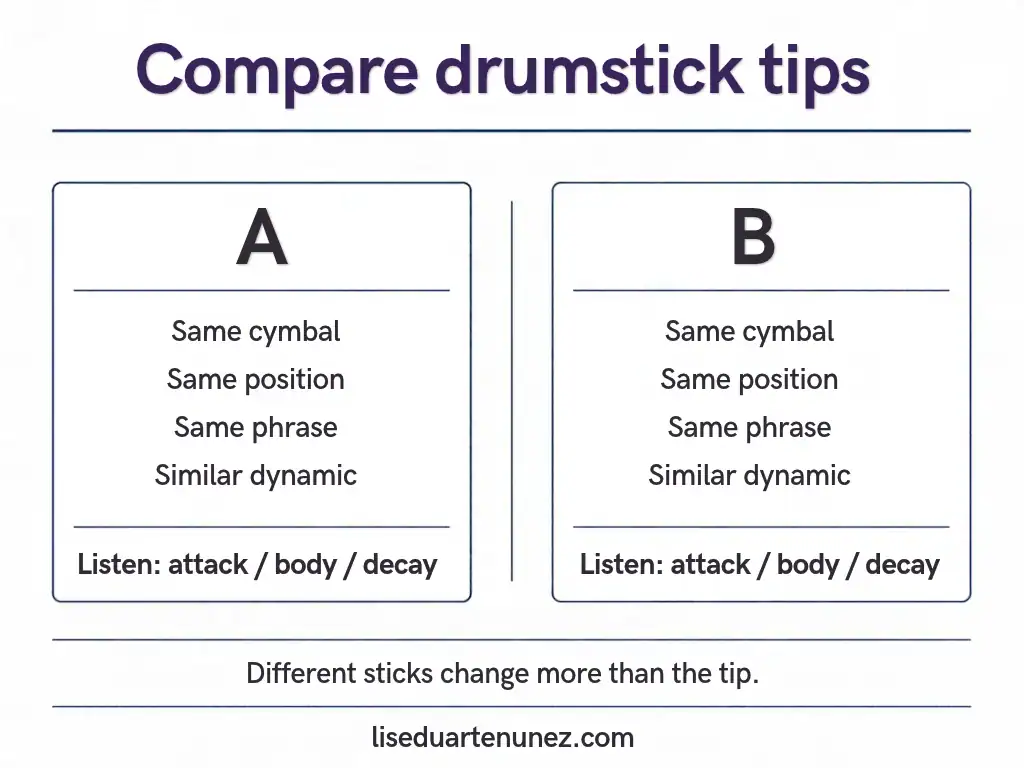
Two complete drumsticks may differ in mass, taper and balance as well as tip shape. A comparison can help you choose between them without proving that the tip alone caused every difference. Note those other variables and inspect the condition of both tips before playing.
Keep the recording position and settings unchanged, check for distortion and repeat the comparison in the opposite order. If your phone adjusts the recording level automatically, be cautious about judging dynamic differences from playback alone.
Separate what you heard from what you prefer and what you will test next:
| Intention | Observation | Decision |
|---|---|---|
| What should this phrase communicate? | What changed in the attack, body or decay? | Which option serves the phrase, and what remains uncertain? |
An isolated sound and a complete phrase can lead you to different preferences. Keep both observations, then test the choice in the musical context where you will use it. For a fuller practice protocol, read how to record percussion practice and listen with purpose.
The same principle beyond the drum kit
The question also exists in other percussion instruments.
Timpani mallets, marimba mallets and vibraphone mallets use different head shapes and materials to control how the beater enters the instrument. A larger or softer head may make the beginning of the impact less abrupt. A smaller or harder contact may produce a more immediate articulation.
The instruments are different, but the underlying question is the same:
How do I want the energy of the gesture to enter the instrument?
That is ultimately what choosing a drumstick tip is about.
Frequently asked questions
Does drumstick tip shape really change the sound?
Yes, especially on cymbals. Tip geometry changes the way the stick contacts the cymbal and can influence the balance between attack, ping, definition and wash. On drumheads, the difference is often less pronounced because the membrane deforms during the impact; tuning, head material, shell, playing position, dynamics and stick mass may have a greater influence.
What is the difference between an oval and a round drumstick tip?
A round tip creates a relatively concentrated contact and is generally less sensitive to orientation. An oval or olive tip is elongated, so its contact changes more noticeably with the striking angle, offering a wider range between focused definition and broader body.
Should I choose wood or nylon?
Choose wood for a traditional, evolving contact and if you are comfortable with the tip wearing over time. Choose nylon if durability, consistency and a clear articulation are priorities. Neither material is universally better; the right choice depends on the instrument, the music and the sound you are trying to hear.
Which tip gives a warmer sound on a ride?
Larger, fuller profiles such as acorn and some oval shapes often produce a broader and less sharply focused response than a small round tip, which may be perceived as warmer or darker. But the cymbal itself matters enormously; a tip cannot turn every bright ride into a dark ride.
Why do wooden drumstick tips chip?
The wood fibres at the contact surface are repeatedly compressed and damaged; rimshots, hard cymbal playing and repeated impacts accelerate the process. Once the tip becomes chipped or flattened, its contact with the cymbal changes. Nylon is generally more resistant to this type of wear, according to the NAMM oral history of Joe Calato, although it is not indestructible.
Which drumstick tip has the best rebound?
The tip shape is not the main variable controlling rebound. Taper, total mass, balance and technique usually matter more. A small tip can contribute to a lighter-feeling front end, but a long taper or a different balance may change the rebound much more dramatically than the profile alone.
Are drumstick head types the same as tip shapes?
When a drumstick guide says “head types”, it usually means the tip or bead: round, oval, teardrop, acorn or barrel. Wood and nylon describe material, not shape. A drumhead is different: it is the membrane stretched across a drum.
How do different drumstick materials affect playing experience?
The stick’s wood affects weight and feel, while a wood or nylon tip changes the contact surface and its wear. Compare sticks of similar dimensions and balance, then notice the effort, rebound and cymbal articulation. The materials section explains why wood species and tip material should be assessed separately.
Find your own sound
A drumstick tip matters. But it matters as part of a relationship.
The result comes from the interaction between the tip shape, the material, the stick’s mass, the taper, the striking angle, the cymbal and the player. No isolated specification can replace listening.
This is why the most useful way to choose a tip is not to memorize a chart. It is to compare, notice and listen for the consequence of each decision.
Technique is not separate from sound. The gesture is not separate from intention. The stick is not separate from the instrument. This listening-first way of deciding is the core of the MTDM Method — and of On Sound Before Gesture: Why Musicians Should Hear Before They Move.
Listen. Compare. Change one variable at a time.
The best tip is not the one that promises the most. It is the one that allows the sound you imagine to arrive with clarity.
If you would like help turning a sound question into a practical comparison, explore my focused one-to-one online percussion lessons. You can discuss your project; bookings and payments are not open yet.
References
- ComPADRE — Vibrating Drumhead
- Physics Today — Acoustics of Drums
- NAMM Oral History — Joe Calato
- MusicRadar — Joe Calato talks Regal Tip past, present and future
- Percussive Arts Society — Joe Calato
- Meinl Stick & Brush — Tip Comparison
- Meinl Stick & Brush — Drumstick Wood Types