An orchestral percussion entrance begins before the first stroke. The music is already moving: a phrase may be gathering tension, an orchestral colour may be changing, or a silence may be holding the listener’s attention.
To prepare the entrance, you need to understand what your sound contributes to that moment. Counting, instrument choice and physical preparation then have a musical purpose.
The following sequence gives you a practical way to work: read the score, hear the context, define the sound, choose the means, then play and evaluate. It is an application inspired by MTDM, whose full framework and working notebook extend beyond these five actions.
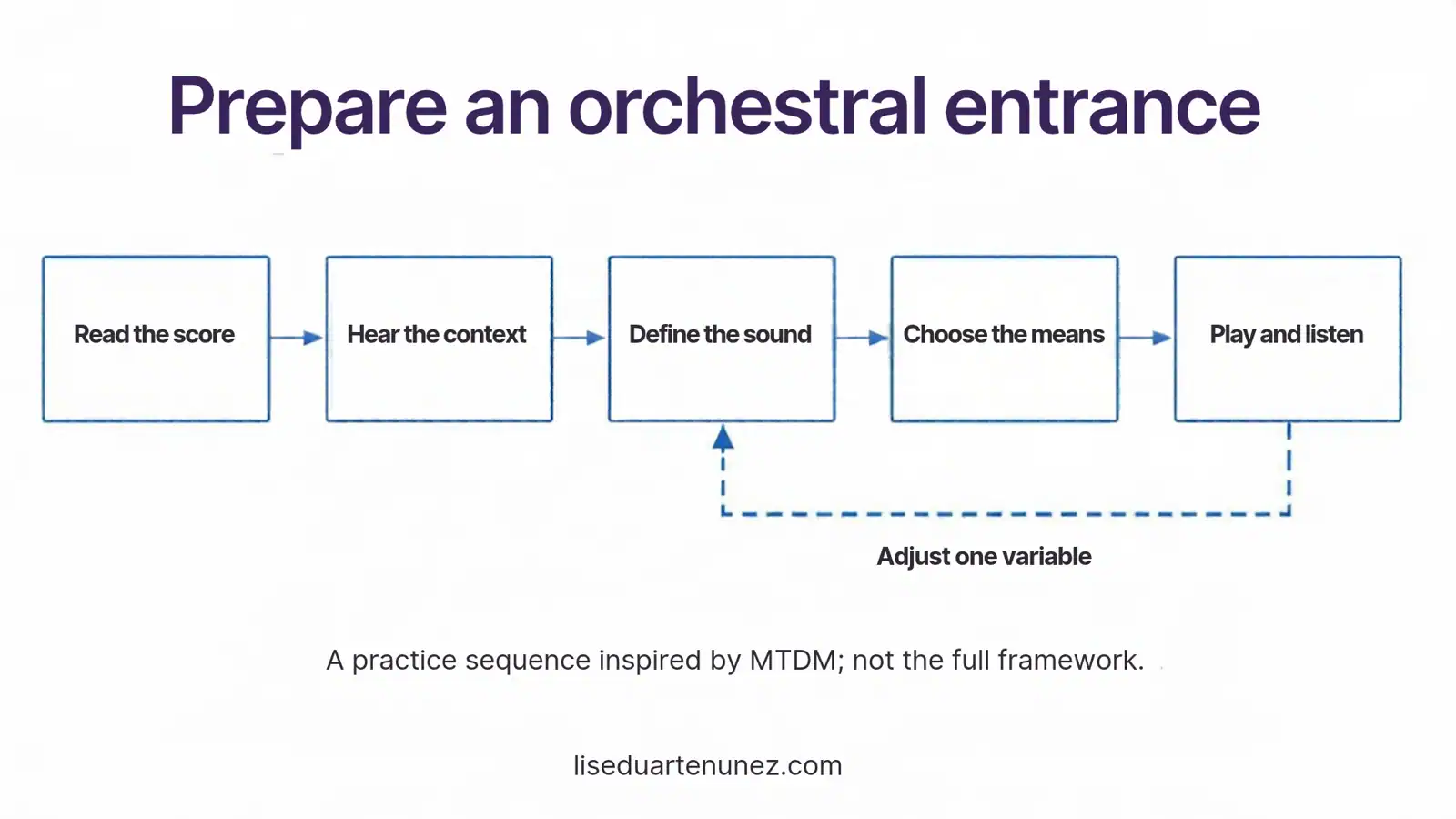
Read what is written, then identify what is missing
Begin with the part. Check the instrument, rhythm, dynamic, articulation, duration and any instructions about resonance or damping. Look carefully at the rests as well as the notes.
Separate explicit information from assumptions. A marking may tell you when to begin without fully specifying how the sound should end. A dynamic can be clear on the page while its balance within the ensemble still needs investigation.
Write down what you need to find in the full score:
- Which instruments lead into the entrance?
- Is your attack shared with another section?
- What changes immediately after it?
- Does the sound belong within a continuing phrase or mark a boundary?
When working towards an audition, also check the organiser’s current excerpt boundaries, edition and instructions. General preparation advice cannot replace that document.
Listen to the music around the excerpt
Start the recording before your passage. Listen far enough back to hear how the phrase develops, then continue beyond your final note.
On the first pass, follow the larger motion. On another, follow the instrument or section that gives you the most useful musical reference. You might notice that a cue you had treated as a simple counting landmark also explains the character of your entrance.
Comparing recordings can reveal different balances, pacing and articulations. Note the orchestra, conductor and version so you know what you compared. A recorded balance is also shaped by microphones and production; it cannot settle every question about the live hall.
Kevin Meyer’s guide to orchestral percussion preparation connects reference listening with decisions about sound and function. It is useful preparation guidance, while its historical audition lists should not be treated as current requirements.
Describe the sound in relation to its function
Try completing this sentence:
“At this moment, the listener should hear…”
Use words that connect to the musical situation. “Clear” may be a start, but clear in what way? A clearly timed beginning? A separate colour above the texture? A sound that remains audible as the harmony changes?
Then add a second sentence explaining the function. You may need to add motion, change a colour, reinforce an arrival or articulate the end of a phrase. Several functions can coexist.
This is the practical value of sound before gesture: the intended result gives you a reason to choose one physical solution over another.
A worked example: one quiet triangle entrance
Imagine a short, invented practice situation. A quiet triangle note enters with the upper strings and remains part of the colour after the initial attack. This is a teaching example, not an instruction for a particular orchestral work.
Your first hypothesis might be:
“I want a clear beginning that joins the strings, followed by enough resonance to remain within the phrase.”
You now have separate things to assess. The attack needs to arrive with the ensemble. Its character needs to suit the texture. The resonance needs an intentional duration.
Prepare a secure suspension and a comfortable position from which you can see the musical cue. With your teacher if needed, select a beater and playing approach appropriate to the instrument. Play the phrase, including the preparation and the end of the sound.
If the attack is too prominent, identify a specific variable to test. You might compare a different beater while preserving the same musical intention and playing area as closely as possible. On another trial, you might explore contact or gesture. Changing everything at once would make the result harder to understand.
If the attack works but the sound disappears too early, investigate that different problem. Check whether your handling or damping is shortening the sound, and listen to the instrument’s natural response. You may eventually need to revise the instrument choice or the original sound image.
There is no universal beater size or gesture prescribed by this example. The purpose is to connect a choice to something you can hear.
Practise the silence and the preparation
Start some repetitions before the entrance. Count the rests, hear the phrase internally and include the movement needed to prepare the instrument.
Check whether that preparation creates an unwanted sound or takes your attention away from the cue. When several instruments are involved, include the preceding change of equipment rather than testing only the comfortable final position.
Continue after the attack. For a resonant instrument, deciding when the sound ends belongs to the preparation as much as deciding when it begins. In rehearsal, adapt those choices to what you actually hear from the ensemble and the conductor’s direction.
Evaluate the result with one clear question
Record a short trial or ask a listener for a specific observation. You might ask whether the attack sounds separate from the phrase, or whether the end of the resonance supports the next event.
Avoid asking a single recording to represent the entire hall. A microphone close to the instrument gives you one listening position. Keep the setup consistent when comparing trials, and use rehearsal or feedback from an appropriate listening position to test the balance further.
Write three short notes:
- What was my intended sound and function?
- What did I hear in this attempt?
- Which variable will I change next, and why?
The answer may be a technical adjustment. It may also be a clearer cue, a different understanding of the phrase or a more realistic sound image.
Carry the decision into the next rehearsal
Keep a brief record of the choice and the conditions in which it worked. Treat it as a proposal that can respond to a different acoustic, tempo or orchestral balance.
Preparing an entrance this way gives the first stroke a place within the music. The written part, the imagined sound and the physical action become connected decisions that you can evaluate and refine.
For guided work on this process, explore masterclasses, workshops and online sessions.