A percussion mock audition gives you a setting in which to play a complete round and examine what happens across it: preparation, excerpts, instrument changes, pauses and recovery after an unexpected moment.
That makes it a different task from recording a short passage for diagnosis. Both can be useful, but they ask different questions. A practice recording may examine one release; a mock audition can examine how you carry musical decisions through a sequence without stopping to repair each detail.
The protocol below is a proposed working framework, not an official jury procedure or a report of a personal trial.
Decide what this simulation will test
Choose a main purpose before arranging the session. Perhaps you want to check transitions between instruments, communicate contrasting characters or discover which passages need attention after a complete run.
Kevin Meyer’s The Orchestral Percussionist: A Beginner’s Guide, published by the Percussive Arts Society, recommends mock auditions with listeners and variation in excerpt order and location. This is pedagogical guidance. Its historical audition-list research covers 2009–2017 and does not establish current requirements.
Begin with a manageable simulation whose conditions you can describe. Change one condition in a later session if that helps investigate a question. More variables do not automatically make the exercise more informative.
Build the round from the actual instructions
For a specific audition, read the organiser’s current documents. Check excerpt boundaries, editions, required instruments and any instructions about repeats, order or equipment. Record unresolved questions rather than replacing missing information with a guess.
If you are preparing generally, write a fictional training round and label it accordingly. For example, it might contain a snare drum excerpt, a keyboard excerpt and an accessory passage, separated by instrument changes. This invented sequence is not a standard audition list.
Prepare individual excerpts through the work described in How to Prepare an Orchestral Percussion Entrance. The mock then tests how those preparations hold together across the round.
Set roles and conditions before playing
Agree who announces excerpts, how the order is determined and whether anyone may request a repeat. Where the real format is unknown, identify your choice as a training condition.
Arrange instruments, music and implements so the simulation includes the necessary changes. Check that the route is clear. Include the actions before the first excerpt and after the last one, rather than beginning only when everything feels comfortable.
Ask listeners to distinguish observations from explanations. A musician outside percussion can report what they heard, while a teacher or percussion colleague may help investigate a technical cause. Neither needs to imitate an imagined jury’s private preferences.
Run the round, then review it in stages
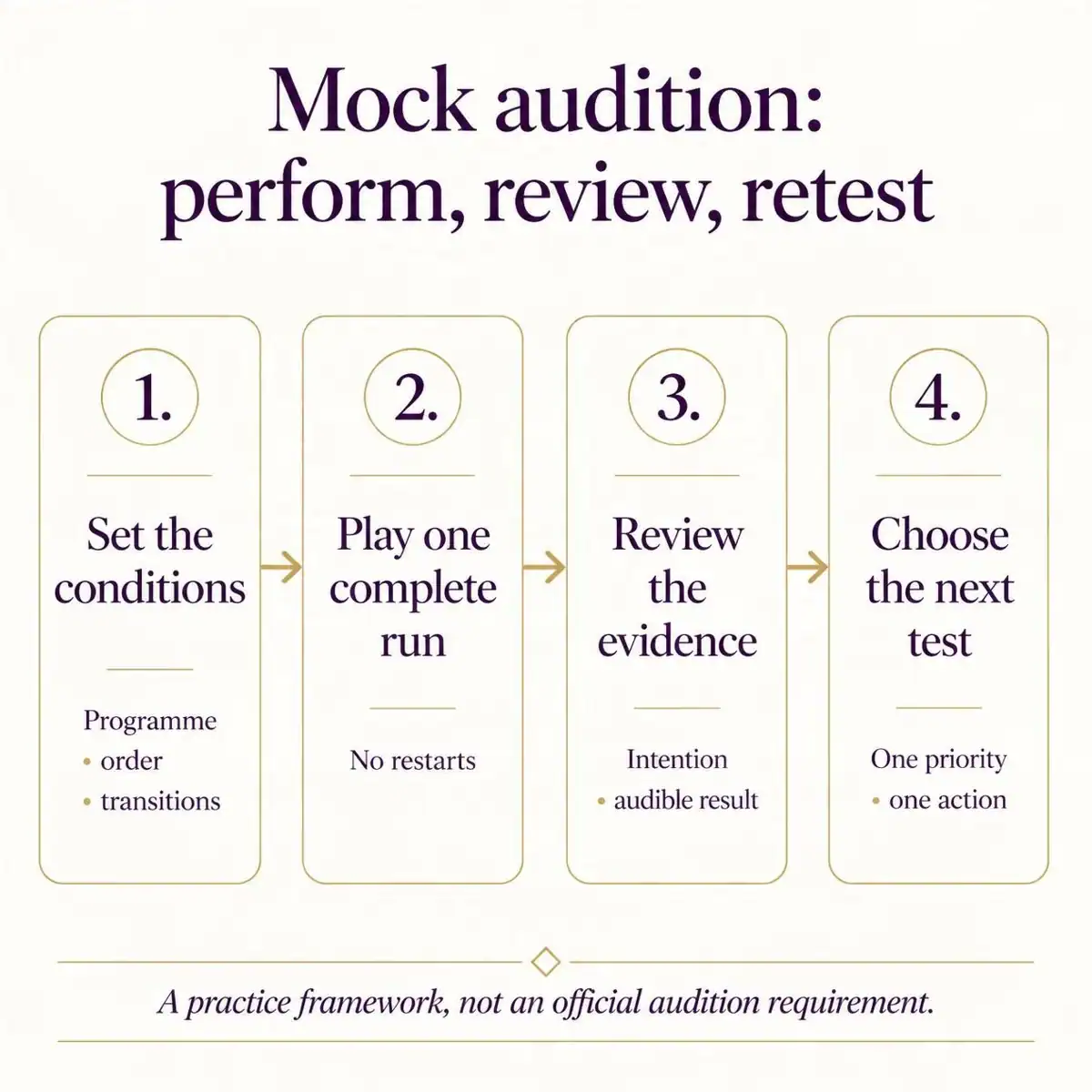
- Write the purpose and conditions. Keep them visible to the person running the session.
- Complete the agreed round. For a continuity test, avoid restarting after every error. If a practical problem makes continuation impossible, stop and document it.
- Make your own brief notes first. Identify what you remember before reading other people’s comments.
- Collect specific listener observations. Ask where something happened and what was audible. Separate the phrase from the equipment transition when necessary.
- Choose one issue to investigate. Return to focused practice before running another complete simulation.
- Repeat with a defined question. State what you want the next round to reveal, rather than simply hoping it feels better.
Recording is optional. Obtain permission from anyone involved before recording or sharing their contribution. If you record, keep the device safely outside your movements and use How to Record Percussion Practice for the subsequent listening work.
Keep a blank feedback sheet
This sheet is a proposed practice tool, not a jury scoring form. Leave room for disagreement or uncertainty.
| Moment or excerpt | Audible or visible observation | Question to investigate | Next test |
|---|---|---|---|
Consider a fictional feedback example: “The second excerpt began faster than the tempo you wrote down.” That observation invites a check of tempo recall and preparation. It does not prove a psychological cause or explain every later fluctuation.
You might test the preparation separately, then return to the same transition in a later round. This links simulation with the observation, evaluation and adjustment work in MTDM.
Short FAQ
Can I run a mock audition alone?
Yes, as a self-run simulation with predetermined instructions. Label that condition clearly: it does not include responding to another person’s requests or receiving an independent listener’s observations.
Should every mock use a different order?
Choose the order to suit the question. Repeating it may help compare a change; varying it can introduce another training condition. Follow the actual audition instructions where they specify an order.
Does a convincing mock predict an audition result?
It gives you evidence about that session. Use it to guide preparation without treating it as a prediction of a jury’s decision.