In Franz von Suppé’s Pique Dame overture, a snare drum passage can look repetitive while asking for several different decisions. The rhythm must remain clear, the dynamics must develop, and the sound after a roll still needs a place in the phrase.
Lise Duarte Nuñez’s Instagram excerpt prompted a useful reader question: can playing repeated eighth notes with one hand help keep the tone consistent? That is a question to investigate, not a rule that every player should copy from a video.
The practice sequence below gives you a way to compare viable stickings while keeping the musical task in view. It does not prescribe Lise’s fingering or claim to explain her intention in the clip.
Watch the Pique Dame excerpt
If the player is blocked by your privacy choices, you can watch this video on YouTube.
Start with the part you actually need
The LSU School of Music’s Spring 2023 audition document identifies a Pique Dame snare drum excerpt as Allegro con fuoco, measures 95–130. On its first page, repeated figures, roll markings, rests and dynamic changes share the same passage.
This is one documented selection, not a universal audition boundary. Read the organiser’s current instructions and your own edition before choosing the passage. The short Instagram performance and the LSU selection should not be assumed to have identical limits.
Before working on speed, mark three things in your copy: where a roll begins and ends, where a rest must remain audible, and where the dynamic changes. A sticking that makes one figure comfortable still has to carry you into the next event.
Keep the pulse through the change of sound
Treat the move between a roll and a separate note as part of the phrase. Begin a practice repetition before that change and continue beyond it. Otherwise, you may solve the roll in isolation without checking the next attack.
Listen for the position of that attack, its dynamic and its relationship to what follows. If it arrives differently from your intention, locate the difference before deciding that the sticking caused it.
The same principle applies to a rest. Do you continue to hear the pulse while nothing is played, or does each new figure become a fresh start? A metronome can provide a reference, but the aim is to retain a sense of the phrase between its sounds.
Compare stickings without changing the question
Choose a short repeated-note passage from your own part. If both a same-hand approach and an alternating approach are already practical for you, compare them. If either requires unfamiliar technique, work on that separately with your teacher first.
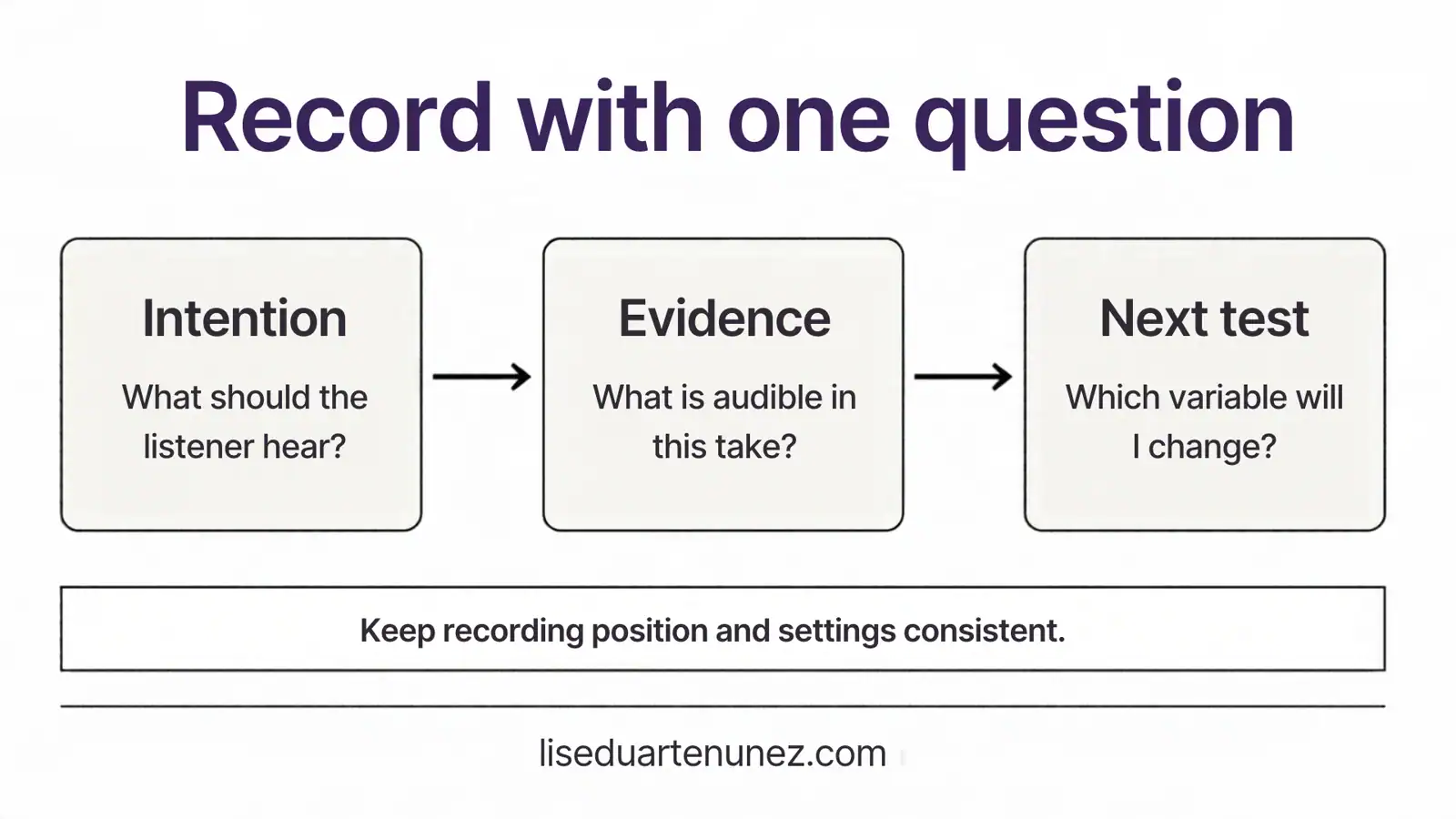
- State the intention. Describe the pulse, articulation and dynamic you want the listener to hear.
- Keep the task consistent. Use the same drum, sticks, passage, intended tempo and recording position.
- Play one solution through. Include the preceding figure and the next entrance, not only the repeated notes.
- Try the alternative. Preserve the musical intention rather than making one version deliberately more accented or louder.
- Reverse the order. Return to the first solution and note whether your impression remains stable.
- Choose a next test. Identify one audible difference, then check it again in a longer phrase.
The comparison does not isolate every variable. A different sticking can change your preparation and the ease of the following figure. Record those differences rather than assigning all of them to the number of hands used.
For the recording setup and a fuller review method, see how to record percussion practice.
Make the decision serve the complete excerpt
Write three short notes: the intended result, what changed between the versions, and what remains uncertain. “The next note entered late in this take” is more useful than declaring a fingering wrong for everyone.
Then restore the complete passage and its written dynamic shape. A choice that helps a repeated figure may be less useful at the transition out of it. Listen to the whole result before keeping the change.
This is a practical application of MTDM: the musical intention guides a technical hypothesis, and the audible result helps you evaluate it. For a separate snare drum question, Delécluse Étude No. 6 explores preserving the main note when ornaments return.
Questions about Pique Dame preparation
Is one hand necessarily more consistent than alternating hands?
Do not decide from the label alone. Compare the actual tone, pulse, dynamic shape and following entrance. The more familiar option in one session is not automatically the best solution in every context.
Must I prepare exactly measures 95–130?
Only if your audition instructions specify that selection. Those are the boundaries in LSU’s historical 2023 document, not current requirements for another organiser.