Sebastian Schmid’s Tambur-ille asks you to make a musical line out of different kinds of tambourine sound. Short figures, sustained rolls and silence need to belong to the same pulse, even when the physical action changes.
Lise Duarte Nuñez’s Instagram excerpt provides a starting point for that work. The question here is not which roll is best in general, but how you prepare the next sound without interrupting the phrase around it.
The sequence below is a proposed practice approach to use with your own score. It is not a transcription of the video or a claim about the intentions behind every gesture in it.
Watch the Tambur-ille excerpt
If the player is blocked by your privacy choices, you can watch this video on YouTube.
Identify the study and the edition
Kolberg Percussion’s performance publication, featuring Leonard Koßmann, identifies the work as Tambur-ille by Sebastian Schmid. Brandt’s catalogue includes it in The Four Etudes for Audition Presentation, alongside studies for triangle, cymbal pair, and bass drum with mounted cymbal. The listed edition is bilingual German and English.
A university-hosted copy of the tambourine part shows a 2/4 opening with the indication Marsch. Separate attacks, roll markings, rests and contrasting dynamics appear within that setting.
Use the copy and instructions relevant to your lesson or audition. A catalogue description or a performance video does not replace the requirements of a particular organiser, and different circulated copies should not be assumed identical.
Read the boundaries between events
Before repeating a difficult passage, identify what changes. Is a separate attack becoming a sustained sound? Does a roll end in silence? Does a quieter figure lead into a written growth?
Mark those boundaries in your copy without adding a technique instruction that the notation does not contain. First describe the sound you want at each side of the change. Then decide what preparation might produce it.
The march indication gives the opening a character to investigate, not a reason to accent every note equally. Keep the written dynamics and articulations in view while listening for the motion across the bar.
Choose the roll inside the phrase
If a transition involves a roll, test whether your present solution can begin, continue and finish as intended. A roll that sounds convincing on its own may still require work when it follows a short figure or leads into another attack.
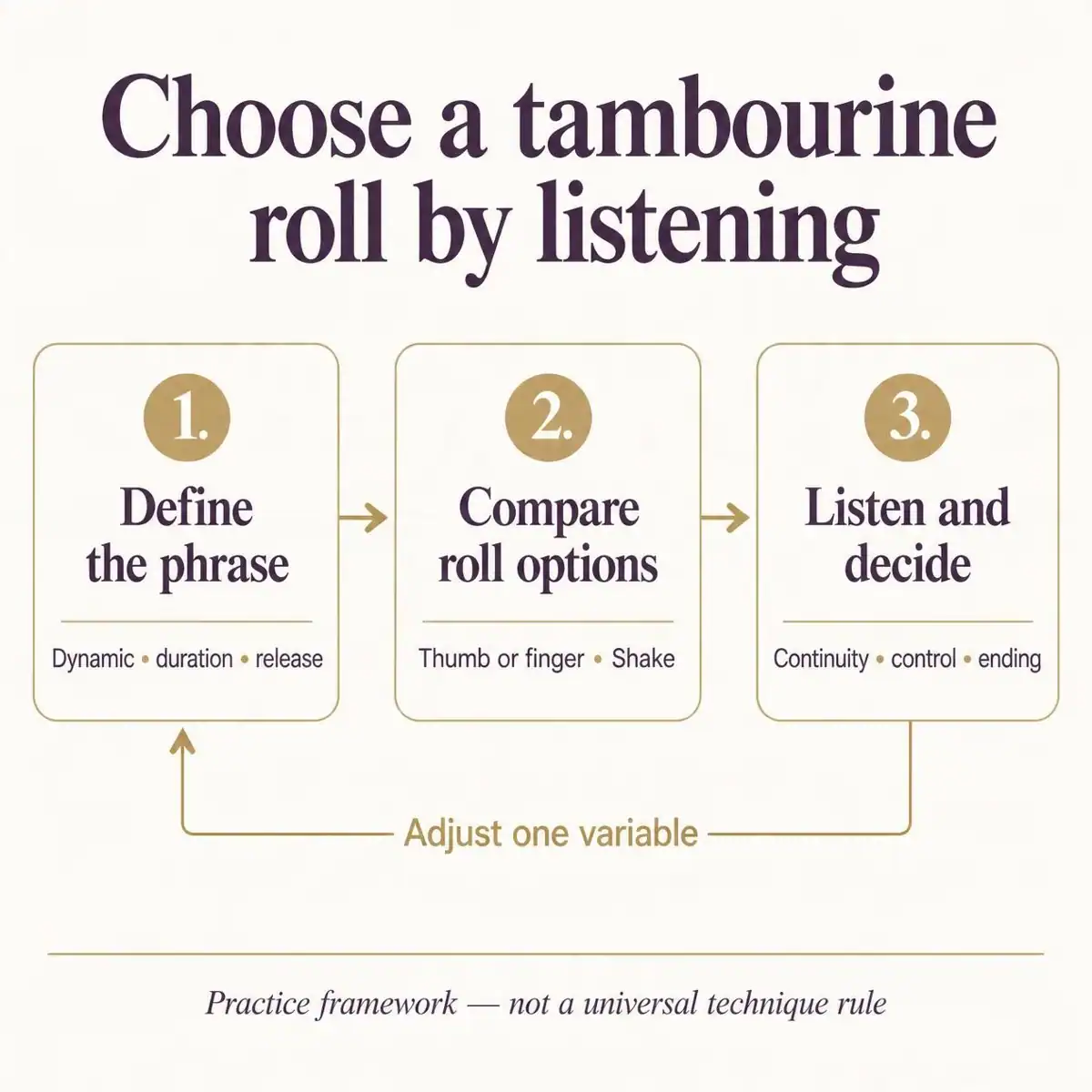
The guide to orchestral tambourine rolls explains a comparison between techniques. Here, take the solution you are considering and investigate how it connects with the surrounding events. Do not assign a technique automatically from the dynamic marking alone.
Practise before, through and after the change
Choose one short transition from your score and give the repetition three parts:
- Before: begin early enough to establish the pulse and the preceding figure’s character.
- Through: include the preparation needed for the next action. Listen for an extra jingle sound, an unintended gap or a new accent.
- After: continue to the next meaningful attack, sustained sound or silence. Check whether it arrives as intended.
Work at a tempo where you can notice the connection. If a physical change is unfamiliar, examine it with your teacher instead of forcing it at speed. The purpose of the short loop is to understand the transition, not to turn it into a new isolated exercise forever.
Once the connection is clearer, lengthen the passage on both sides. Restore the written pacing and dynamic shape, then check whether the same preparation still serves the music.
Separate what you hear from its possible cause
A short recording can help you revisit the moment of change. Keep the device position and settings consistent; see how to record percussion practice for the setup.
Write one observation and one next test. “An extra sound appears during preparation” locates a question. It does not yet prove which part of the movement caused it. You might review the preparation separately, then listen to the full transition again.
This connects the study with MTDM: define the intended sound, choose a practical hypothesis, evaluate the result and adjust. The next complete run tests whether the local decision helps the study remain a phrase rather than a collection of techniques.
Questions about studying Tambur-ille
Is there one prescribed roll technique for every passage?
Follow any explicit instruction in your edition. Where a choice remains open, test the onset, continuity, release and connection with the next event rather than treating one technique as a universal answer.
Does its audition context make this a current requirement everywhere?
No general claim about auditions can replace an organiser’s current list. Prepare the work when it is required or useful for your study, and verify the actual selection separately.