Preparing the Sacrificial Dance timpani excerpt means more than memorising a sequence of time signatures. You need to know how long each group lasts, where your attacks belong, and how to continue through rests without treating every bar as a new start.
Lise Duarte Nuñez’s Instagram excerpt brings that rhythmic challenge into focus. The practice plan below starts with your own part and its surrounding score. It is not a transcription of the clip or a fixed counting system for every edition.
Watch the Sacrificial Dance excerpt
If the player is blocked by your privacy choices, you can watch this video on YouTube.
Locate the passage before choosing a counting system
The Sacrificial Dance, also known as Danse sacrale, concludes Igor Stravinsky’s The Rite of Spring. Boosey & Hawkes’ catalogue places the dance at the work’s culmination and lists two timpani players in the orchestration. Check which part and passage you are preparing rather than assuming that a short video represents the complete timpani writing.
The Civic Orchestra of Chicago’s 2026–27 repertoire list includes Sacrificial Dance under timpani. That documents one audition context; it does not establish universal excerpt boundaries or requirements for another organiser.
Write the edition, rehearsal marks, part assignment and any tempo changes at the top of your practice notes. Resolve a mismatch between copies before committing a long sequence to memory.
Build a map of durations, not just labels
Choose a short passage containing a meter change. Read it without playing and make a compact map with four entries:
- Reference unit: which written note value are you tracking, and does its duration remain the same across this change?
- Group length: how many of those units fit before the next barline or useful landmark?
- Attack position: where does each played note fall within the group?
- Continuation: what follows the last attack, including any written silence?
Take the values from your score. If the tempo relationship or notation changes, record that relationship explicitly instead of forcing one unchanged subdivision through it. A new time signature is not, by itself, an instruction to accelerate or slow down.
Speak the map while keeping a reference pulse. Then check the same passage against the score again. The purpose is to hear the duration of the group, not simply to recite its name quickly enough.
Separate the rhythmic route from movement between drums
First speak or lightly tap the rhythm on one surface. Keep the written rests and dynamic intentions in the plan, even when the physical task is simplified. This is a diagnostic exercise, not a replacement version of the part.
Then restore the written pitches on the timpani. Notice whether the route between drums changes the timing of the next attack. If it does, identify the preparation that needs work rather than immediately changing your counting system.
Begin repetitions before the difficult boundary and continue into the following group. A successful isolated bar does not yet show that you can arrive at it or leave it in time.
Prepare a re-entry rather than relying on a restart
Choose several clear landmarks in the score. For each, practise hearing the preceding context, counting the space before your entrance, and continuing beyond the first note. Use actual orchestral cues where you have checked them in the score; a rehearsal number is a location, not an audible cue.
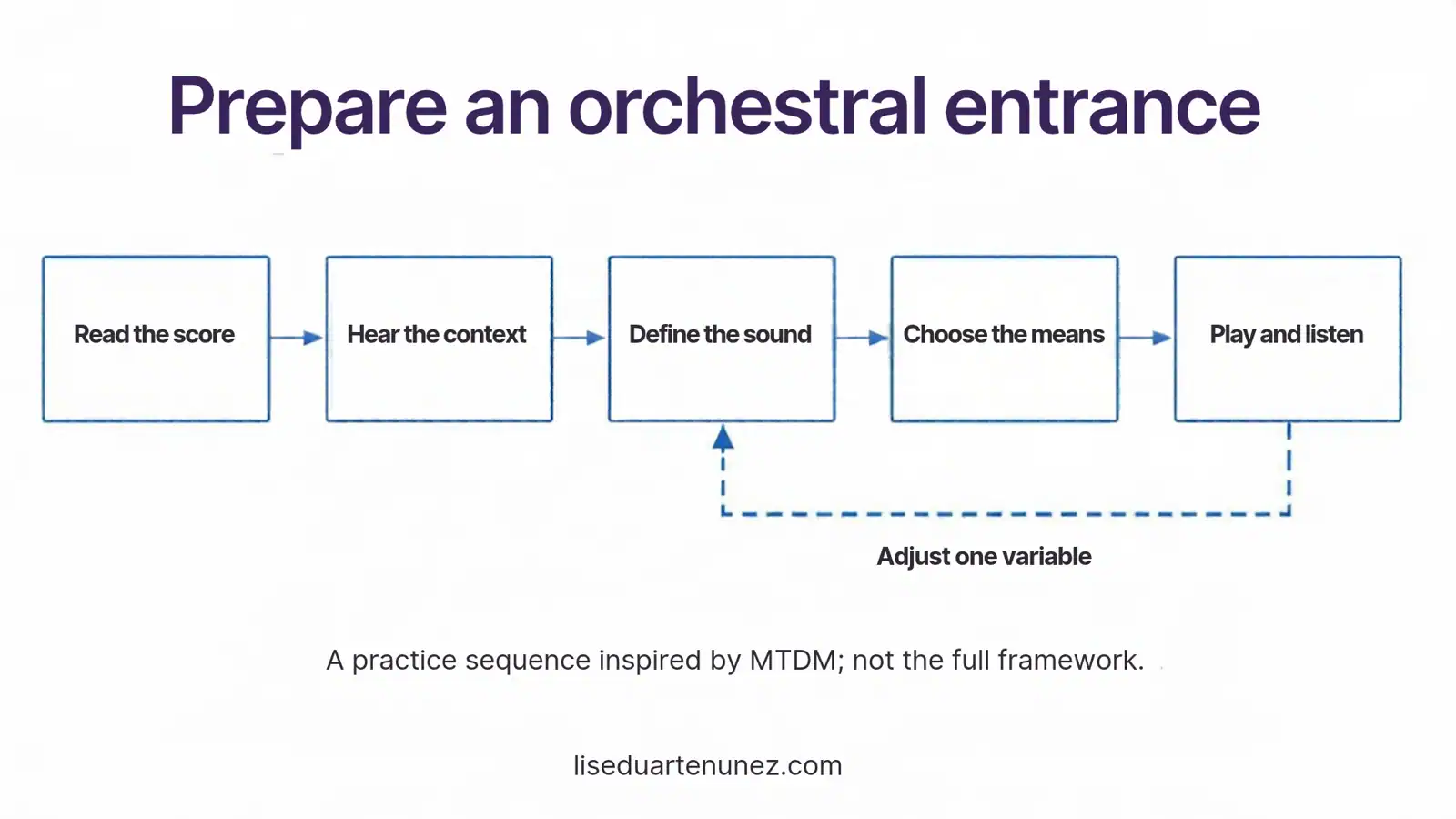
The orchestral entrance guide develops this preparation further. The London Philharmonic Orchestra’s published performance also offers a full-ensemble reference for your own listening; match the passage to your copy before using it as context.
Check continuity in a complete take
After local work, record the selected excerpt without restarting. Listen for one question: does the duration across the chosen meter change remain what you intended? Note the location of a discrepancy before proposing its cause.
Keep recording conditions consistent using the practice recording guide. Then test one adjustment and return to the complete selection. This follows MTDM: make the musical intention explicit, choose practical means, evaluate and adjust.
Questions about the Sacrificial Dance timpani excerpt
Should every new meter feel like a new tempo?
No. Follow the written tempo relationships. Practise hearing different group lengths within the relevant reference unit, rather than changing speed automatically at each barline.
Is memorising the meters enough?
It is only part of the task. Check attack positions, rests, movement between drums and the continuation after each landmark. Restore the complete passage to find out whether the map supports the music.