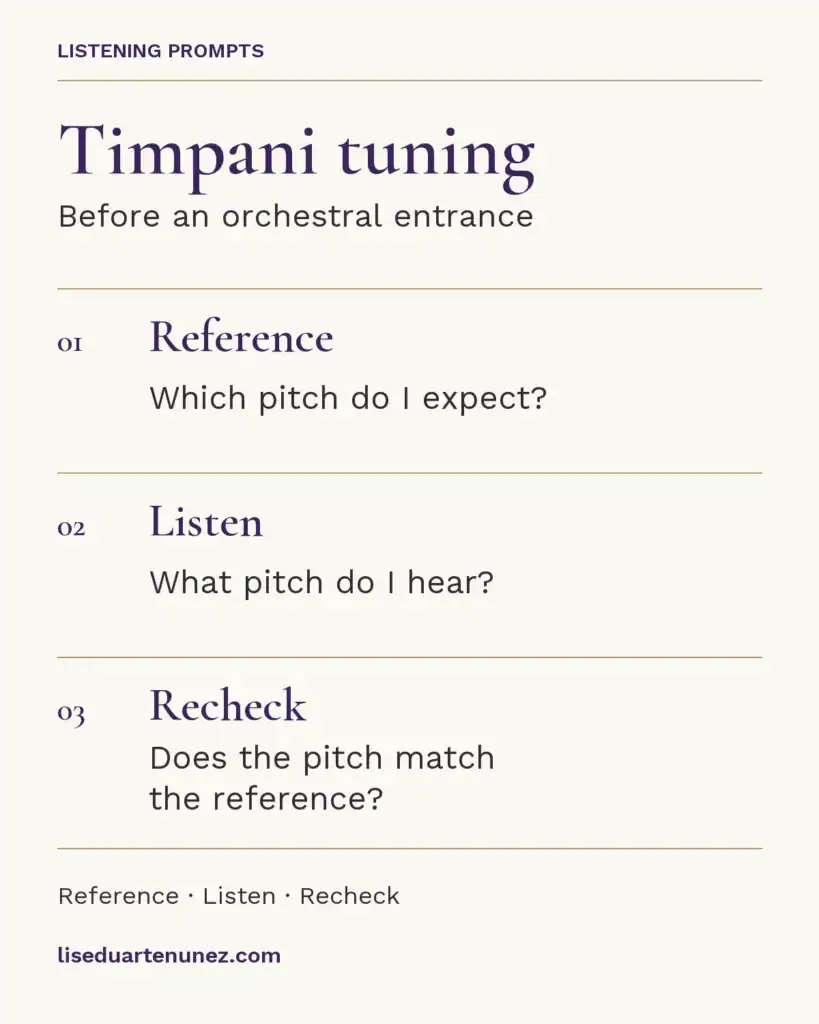
Timpani tuning is not complete when the pedal or gauge reaches a familiar position. You still need to check the pitch that actually sounds. A useful practice routine connects a clear reference, an imagined note, a controlled adjustment and a fresh listening check before the entrance.
The aim is not to make tuning a separate ritual. It is to arrive at the next note knowing what you intend to hear, what you have checked and what still needs attention.
First, separate pitch-setting from instrument setup
Two different tasks are often called tuning:
- Setting a musical pitch: preparing a functioning timpano for a required note and checking the result.
- Setting up the head and mechanism: making the head respond evenly and establishing the instrument’s working range and pedal balance.
Yamaha’s maintenance guide for timpani treats head clearing and pedal balance as setup work. This article does not reproduce those procedures. It assumes an instrument that is already set up and a player who has been shown how to operate that particular model.
Do not use a general listening exercise as instructions for turning tension rods or adjusting a spring. If the pedal will not hold its position or the head produces an unclear, inconsistent response, involve the teacher or person responsible for the instrument before continuing.
Establish the note before moving the pedal
Start with the musical requirement:
- What is the written pitch, including its octave?
- Which drum will play it, within that instrument’s approved range?
- What reference will you use?
- What pitch change comes before it, and how much time does the score allow?
Use the reference agreed for the musical situation rather than assuming one setting is appropriate everywhere. A note name is not enough if the octave or reference remains uncertain.
For an exposed entrance, identify what the note belongs to: a harmony, a bass line, a rhythmic gesture or a change of colour. The preparation should include that relationship, not only the isolated sound.
How to tune timpani by ear: a listening-led routine
David Collier’s timpani teaching guide for Yamaha combines sounding a reference, singing the target and listening while adjusting the drum. He also recommends developing pitch and interval hearing rather than relying only on the gauges.
Use that listening-first principle as a starting point for supervised practice:
- Hear the reference. Use a reliable source, such as a keyboard or tone generator, and identify the intended octave.
- Retain the target. Sing or hum in a comfortable register, while keeping clear which octave the drum must produce. Work with a teacher if you cannot yet retain the note reliably.
- Set the pitch. Use the pedal movement you have been taught for the instrument, within its working range. This guide does not prescribe a universal pedal direction or mechanical adjustment.
- Listen to a clear, quiet stroke. Compare the sounding note with the reference rather than judging the pedal position alone.
- Check again. If uncertain, return to the reference and repeat. A guess repeated confidently is still a guess.
Accuracy comes before speed in this exercise. Introduce the time pressure of a passage only when you can hear what needs correcting.
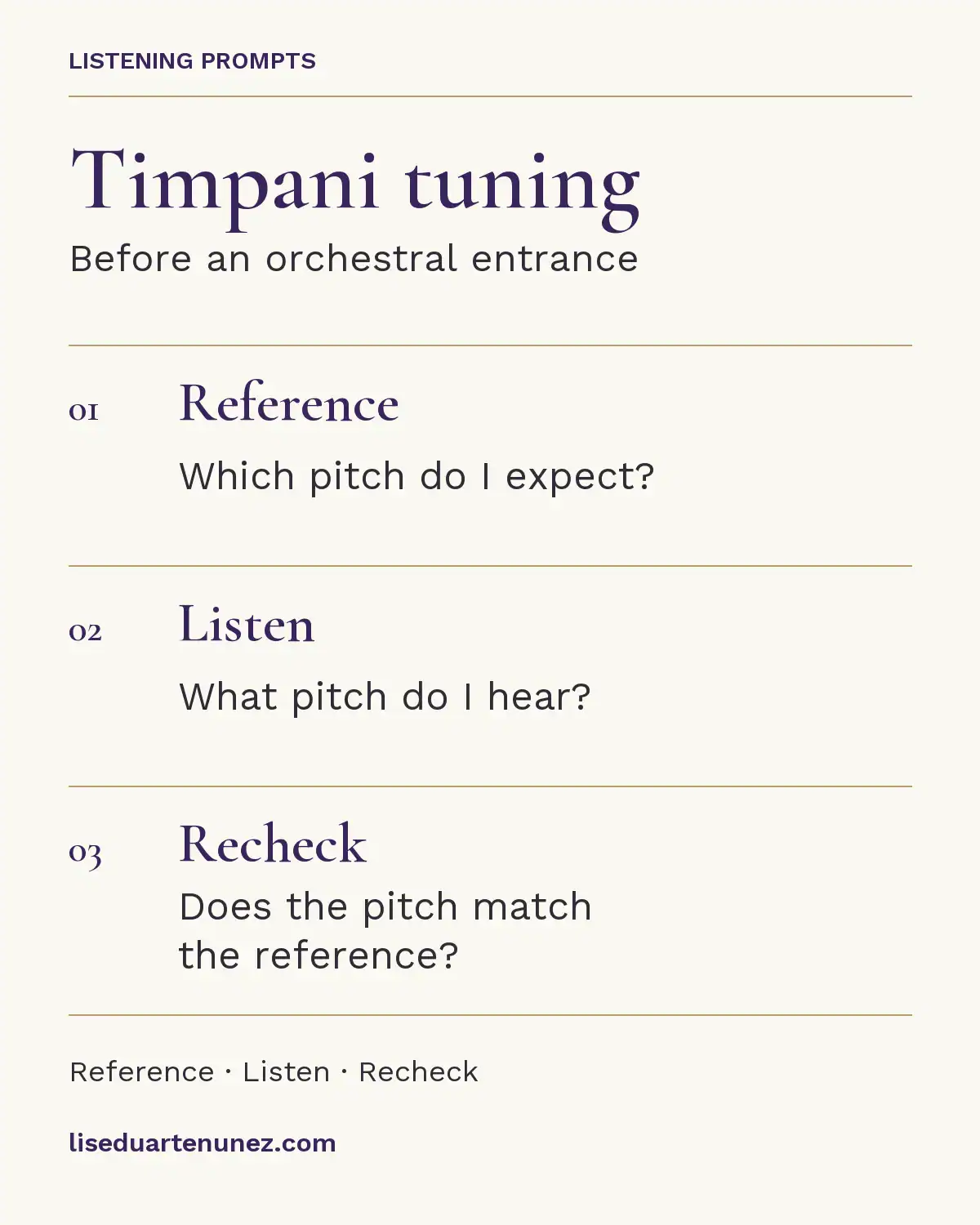
- Reference: Which pitch do I expect?
- Listen: What pitch do I hear?
- Recheck: Does the pitch match the reference?
What should you listen for?
A timpani tone is not a single pure frequency. In The Timpanist’s Ear, Alison Shaw discusses work with Ed Martin that connects tuning with hearing the instrument’s partials and with playing in harmony.
That distinction matters when a sound seems clear in isolation but uncertain in context. Ask whether you are retaining the required musical pitch or being distracted by another component of the tone.
Try alternating the reference and the drum, then hearing the note within a simple, agreed harmonic context. Do not turn a difficulty in identifying pitch into an automatic diagnosis of faulty hardware. Equally, do not assume an unstable instrument can be solved by listening harder.
Timpani tuning gauges and electronic tuners
A gauge can help you locate an approximate position. It does not listen to the drum. Practising without watching it, as Collier suggests, is a way to test whether your ear is making the decision.
An electronic tuner can provide another check, but first know what you are asking it to confirm: the note, the octave and the reference setting. If its display is uncertain or appears inconsistent with what you hear, pause and establish a clear comparison instead of chasing every changing indication.
The useful sequence is not “look, move, trust.” It is “hear, decide, check.” Neither the ear nor the display should be treated as infallible when the reference itself is unclear.
Practise the pitch change, then the return to playing
Finding a note once is different from preparing it reliably inside a passage. In practice, include the action that comes before the check and the entrance that follows it.
Use a short record of the decision:
| Before the entrance | What to establish | What to check |
|---|---|---|
| Required note | Pitch, octave and chosen drum | Is the target unambiguous? |
| Previous action | Earlier note, rest or pitch change | Can you complete the preparation without rushing? |
| Reference | The source and agreed setting | Can you retain the target after the reference stops? |
| Sounding result | The note you actually hear | What supports your judgement that it matches? |
| Next attempt | One uncertainty to resolve | Does repeating the sequence produce the same result? |
This is a proposed practice framework, not a claim that every pitch change requires an audible test during performance. Decide with your teacher what checking is possible and appropriate in the real passage. A quiet practice stroke may still be inappropriate during someone else’s exposed music.
A constructed practice example
Choose two pitches that your teacher has confirmed are suitable for the drum. Prepare the first, play a short phrase, allow a planned pause, then prepare the second and return to playing.
Afterwards, separate two questions: did the second note match the intended pitch, and was the entrance ready at the intended time? If one failed, slow the exercise and isolate that part. Do not respond to a late entrance by accepting an uncertain pitch, or to an uncertain pitch by abandoning the musical timing indefinitely.
This is an illustrative exercise, not a quotation from an orchestral score or a report of Lise’s own performance.
When the result is uncertain
| Observation | A useful next check |
|---|---|
| The target becomes unclear after the reference stops | Repeat the reference-and-voice exercise before moving the pedal again. |
| The gauge looks familiar but the note sounds wrong | Recheck the actual pitch and octave against the reference. |
| You can match the note slowly but lose it during a change | Practise the complete preparation at a manageable pace, then shorten the available time gradually. |
| The sound is difficult to identify consistently | Ask the teacher to listen and distinguish a listening problem from an instrument setup problem. |
| The pedal will not remain where you place it | Stop the exercise and ask the instrument’s responsible person to inspect it; do not guess at mechanical adjustments. |
These checks help locate the next question. They are not a mechanical troubleshooting manual or a guarantee that one cause explains every symptom.
Bring the pitch check back into the music
The preparation of an entrance also includes pulse, character and what is happening around you. Use How to Prepare an Orchestral Percussion Entrance for that wider sequence.
For different musical questions, continue with Beethoven 9: timpani resonance in bars 16–35 or Sacrificial Dance: practising timpani meter changes. Those guides address resonance and rhythmic preparation, not the head setup of your instrument.
The objective is a repeatable decision: know the intended note, use a clear reference, hear what the drum produces and make the next preparation deliberately. A successful check should help you return your attention to the phrase.
For individual work on a specific musical project, explore the focused online percussion lessons. You can discuss your project; bookings and payments are not open yet.
Sources and further reading
- David Collier, Timpani Teaching Tips: Fix Common Student Mistakes with Sound, Rolls, and Tuning, Yamaha, 8 January 2021; consulted 18 October 2026.
- Alison Shaw, The Timpanist’s Ear: A Comprehensive Approach to Timpani Tuning, Black Swamp Percussion; page identifies the original publication as 2012; consulted 18 October 2026.
- Yamaha Music Australia, A Maintenance Guide for Timpani for Non-Timpanists, publication date not established; consulted 18 October 2026. Included to distinguish instrument setup from musical pitch checking, not as a universal service procedure.