Concert bass drum technique involves more than placing an attack. A note also needs a duration and an ending that belong to the phrase. Before changing mallets or adding muffling, decide what you want the sound to do after the stroke.
This guide focuses on orchestral concert bass drum playing, not bass drum pedal technique for drum kit. Its practical question is specific: can you keep the same intended attack while preparing two different endings?
Start with the musical ending
Read the passage before choosing a way to control the resonance. Identify the attack, the written duration and the next musical event. Check any articulation, damping instruction or conductor’s request. If the ending remains unclear, make it a rehearsal question rather than treating one solution as automatic.
Try describing the aim in a sentence: “The sound should support this arrival, then leave space before the next event.” That is a more useful starting point than “I need a drier bass drum.” A shorter sound is not inherently more musical, and a longer one is not inherently more expressive.
Keep the entrance and ending in the same plan. The orchestral percussion entrance guide develops the preparation of the first event; here, the emphasis is what happens afterwards.
Resonance, muffling and release: separate the decisions
In his Interlochen lesson on bass drum playing, Keith Aleo identifies sustain management as a central challenge. His transcript describes comparisons between playing areas and different amounts of muffling. These are sound choices on the instrument being demonstrated, not a universal recipe for every drum.
For this exercise, use two working distinctions:
- Shaping the response: damping or muffling already present as you play, affecting the sound you start with.
- Planning the release: deciding when and how to bring an already-sounding note to its intended end.
Teachers may use these words differently. What matters is knowing which decision you are changing. If you alter the mallet, playing area, dynamic and damping at once, it becomes harder to identify what helped.
Use a stable setup and a release method already taught for that drum. Ask your teacher to confirm that you can reach comfortably and prepare the ending without compromising balance or the attack. This article does not prescribe a foot support, body position, amount of pressure or maintenance procedure.
An exercise: same attack, different ending
The following is an original planning exercise, not a passage from a score or a claim about measured sound decay. Choose a comfortable steady pulse and count 1, 2, 3, 4 at equal intervals.
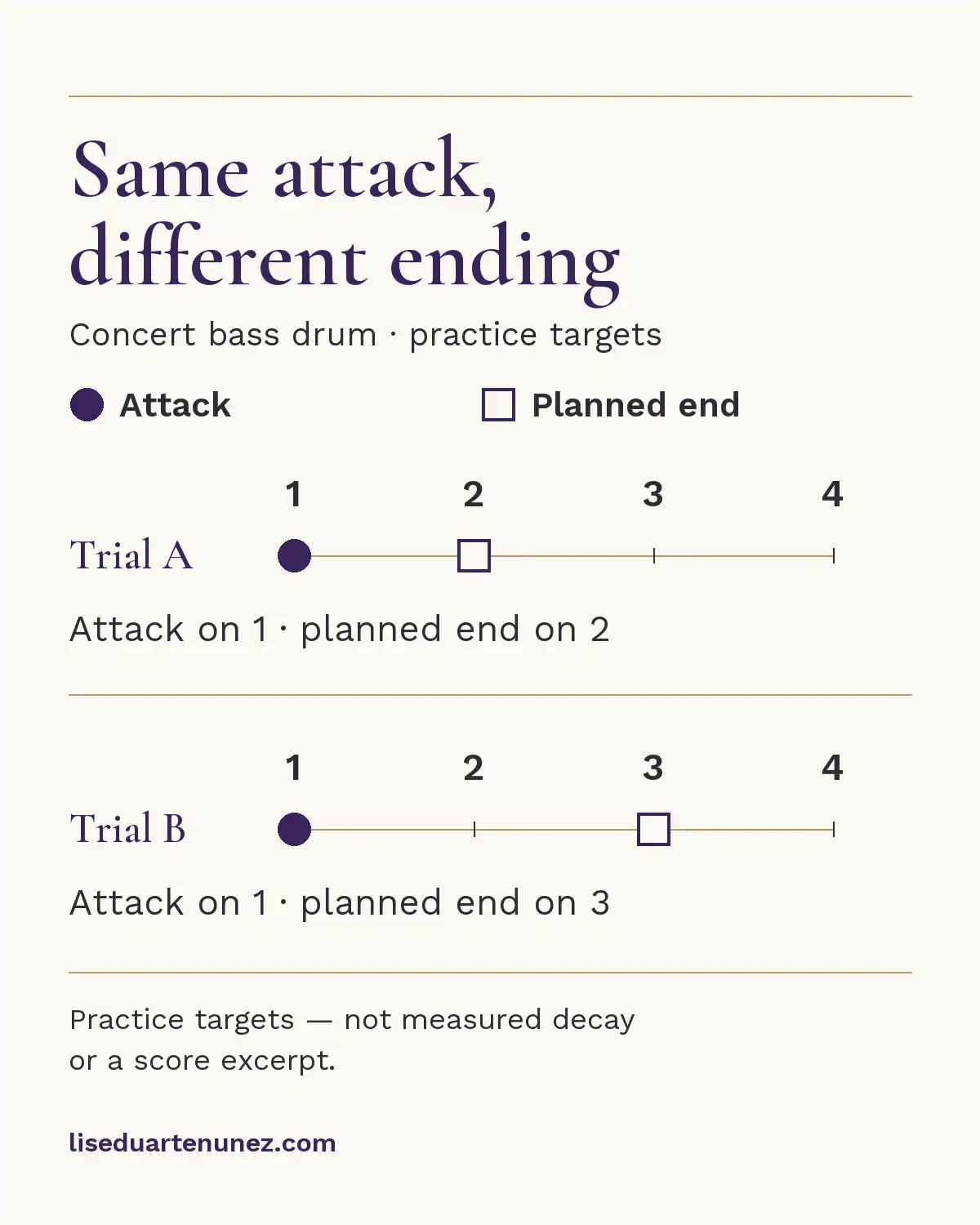
Text version of the diagram
- Trial A: one attack on count 1; planned ending on count 2. Continue counting through 4 without another stroke.
- Trial B: one attack on count 1; planned ending on count 3. Continue counting through 4 without another stroke.
- A filled circle marks an attack; an open square marks the planned ending. The connecting line is a timing reference, not an audio trace.
Keep the same mallet, intended dynamic, playing area and listening position for the pair. Keep any initial damping arrangement unchanged too. The variable is the target time of the ending, not a simultaneous equipment comparison. “Same attack” means the same intention; it does not assert that two strokes are acoustically identical.
Before each attempt, count through the whole plan mentally. Then play once and listen beyond the ending you intended. Use only a familiar, teacher-approved way of ending the sound. If the proposed timing cannot be reached comfortably on your setup, pause and adapt it with your teacher rather than forcing the movement.
Listen for the difference, not just the stroke
After the two trials, answer three questions:
- Did the initial sound remain close enough to the same intention for the comparison to be useful?
- Was there a recognisable difference between the earlier and later planned endings?
- Did preparing the ending distract you from placing the attack?
Write a short observation, not a verdict on your ability: “In trial A I shortened the attack while anticipating the ending.” Your next pair can keep the same targets while checking that specific issue.
If you record the comparison, leave the recording setup unchanged. The percussion practice recording guide explains how to keep a listening question in focus. A recording includes the room as well as the instrument: an audible tail alone does not establish why a planned ending seems unclear. Describe what you hear and discuss an uncertain result with your teacher instead of diagnosing the drum from one take.
Transfer the exercise back to orchestral playing
The counts above are practice targets, not instructions to shorten every written note. Return to the actual part and its musical context. Decide where the bass drum’s sound belongs in the phrase, check the conductor’s indication and test the ending with the ensemble when possible.
If a different mallet or damping arrangement seems necessary, compare it in a separate pair of attempts. Keep the intended musical result explicit. This avoids replacing a question about duration with an unstructured search through equipment.
The Faust cymbal article approaches the ending of a sound on a different instrument. The shared listening question is useful; the physical means of release are not interchangeable.
For individual guidance, explore the outline of focused online percussion lessons. Bookings and payments are not open yet. A useful question to bring to a lesson is concrete: “Can we compare the ending I planned with the one we actually hear?”
Sources and further study
- Keith Aleo / Interlochen Center for the Arts, How to play the bass drum properly, 3 April 2023. The published transcript informs the discussion of sustain and sound choices; the exercise and diagram above are original editorial proposals.
- Vic Firth Artists & Education, Percussion 101: Concert Bass Drum, undated page. An official starting point for further study of maintenance, implement selection and playing techniques. Its study questions are not used here as an answer key or as evidence for a particular damping method.
Sources consulted 19 October 2026. This focused exercise complements instruction; it is not a complete guide to bass drum tuning, rolls or physical technique.